Spectra, Schenker, or Rainman — the watermaker question I keep circling
Three watermakers, three failure modes, and I still don't know which one I want at 200 miles offshore with four kids aboard.
Cameron Hunt - Bluewater Navigator (Page 2)
Three watermakers, three failure modes, and I still don't know which one I want at 200 miles offshore with four kids aboard.
The 3,000-mile leg from Galapagos to the Marquesas hinges on one GRIB pattern I keep watching.
Most cruising-cost articles are written by someone who hasn't owned the boat. Here's the honest five-year number for a family of six on a 50-foot catamaran.
On a cruising cat, lateral resistance is the choice you make once and pay for in maintenance, draft, anchorage selection, and resale for as long as you own the boat. Three months into our worksheet, I keep moving — here's the case for both, and where I think we'll land.
A French listing, ten-year-old standing rigging, and a refit math problem I'd rather solve before falling in love with the hull.
The right time to take the kite down is two minutes before you think you should. The wrong time is three minutes after.
Most anchoring failures aren't anchor failures. They are scope failures, ground failures, and the lazy version of a perfectly good technique.
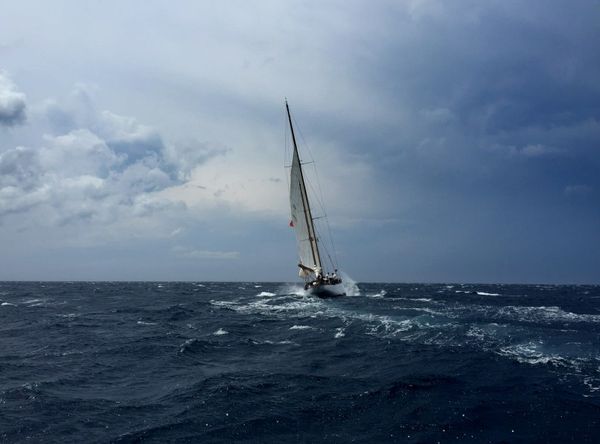
There is no single correct heavy-weather tactic. Picking the wrong one for your boat and sea state is how good crews get into trouble.
The biggest multihull show ever doesn't tell you much by itself. The trends in the boats moored four-deep at La Grande-Motte do.
A new course record on the RORC Transatlantic isn't just about big numbers. It's about what stability margins look like when the boats keep getting faster.
The breeze went north and the swell stacked up. Crews who stopped checking GRIBs and started looking out the windows had the better day.
Three-on/three-off, four-on/four-off, Swedish system, Pardey four-and-six. They produce very different rest. Here's what works for which crew, with the sleep math attached.