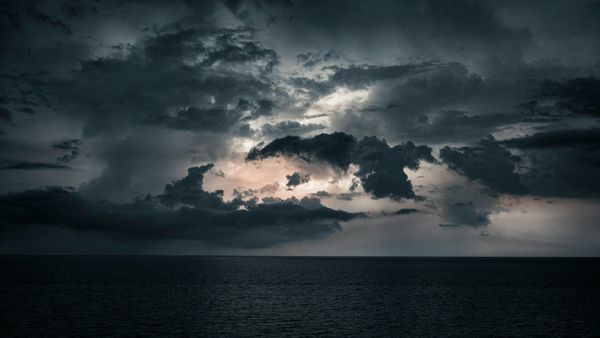
What I want the GRIB to show before leaving Galapagos
The 3,000-mile leg from Galapagos to the Marquesas hinges on one GRIB pattern I keep watching.
This post contains affiliate links — see disclosure.
The Galapagos to Marquesas passage is the leg of a circumnavigation that gets the most romantic treatment and the least careful planning, at least in the writeups I've been reading. Three thousand nautical miles, eighteen to twenty-four days for most cruising cats, almost all of it downwind. Sounds easy. Then I look at GRIBs from past March-April-May windows and I see why people end up motoring through the doldrums for two days, or running ragged through enhanced convergence squall lines for forty hours.
So I've been building a checklist for what I'd want the forecast to show before I'd actually untie the lines on the 50-foot cat we're researching. Five things, and most of them aren't about where the wind is — they're about where the wind isn't.
First, I want the southeast trades filled in to at least 12 knots by 2°S, extending west to roughly 110°W. Anything weaker and you're motoring across the equator, which is fine if you have the fuel, but it eats your reserve before the passage has really started. The trades typically hit their seasonal weak point in May-June; by July the southern hemisphere winter starts pushing them harder again, but by then the cyclone risk on the back end of the passage is rising too.
Second, I want the ITCZ visualized as a band less than 120 nautical miles wide on the meridian I plan to cross — usually somewhere around 130°W. Most forecast models show it as a yellow-green stripe on TPW or convergence overlays. Anything wider than that and you're in convective wind for half a day or more. PredictWind's ECMWF run is what I'd anchor to, with the GFS as a second opinion. They often disagree on ITCZ width by 30-50 nm, which matters a lot at the scale of a small boat.
Third, I want no enhanced convergence cells in the band on the day of crossing or the day after. These show up as deeper red blobs on the convergence chart and they're squall factories. A normal squall train gives you 25 knots and rain for an hour. An enhanced cell will give you 40+ for half a day, with confused seas and a wet crew.
Fourth, I want the South Pacific High sitting somewhere around 30°S, 130-140°W. That's what's driving the trades I'm going to ride for the back two-thirds of the passage. If it's elongated or split into two centers, the trades behind the ITCZ end up lumpy and inconsistent, and the rhumb line stops being the right answer.
Fifth — this is the one I keep going back and forth on — I want a five-day clean GRIB before I leave. Not seven, because that's asking too much and you'll never go. Not three, because you can't make the equator from Puerto Ayora in three days. Five is enough to get the boat south of the equator and into the steady SE flow before the next forecast cycle becomes the relevant one.
The classic Puddle Jump wisdom is "leave on the first window in March," but our family schedule probably puts us in the late-April window if we go in 2027 at all. That's marginal on the trades. So I'm running historical reanalysis on Cornell's Ocean Atlas and PassageWeather hindcasts to see how often a late-April window has actually delivered. Early read is about 60% of years it's clean enough. The other 40%, you're motoring or waiting.
I haven't decided whether 60% clean is good enough to plan a season around, or whether we shift the whole route a year and start the Pacific in 2028. Open question. The worksheet keeps getting longer.