What a Five-Year Family Circumnavigation Actually Costs (And Why $1M Doesn't Cover It)
Most cruising-cost articles are written by someone who hasn't owned the boat. Here's the honest five-year number for a family of six on a 50-foot catamaran.
I added up my own circumnavigation budget last weekend, double-checked it against three families I know who are actually out there, and arrived at a number that's about double what the cruising magazines tell you. That gap exists because almost every online "cost of cruising" article is built from the wrong starting boat, the wrong family size, and a refit reserve that looks like a typo.
I'm a financial advisor in Bend, Oregon, with four kids and a wife who, against the odds, agreed to spend five years on a 50-foot catamaran with all of us. I plan budgets for a living. So when I started costing out our circumnavigation, I treated it the way I'd treat a client's retirement projection — assume reality lands at the unhappy end of the range, set aside what feels like too much, and only then look at whether the math works.
It does, eventually. But the honest number is harder than the internet wants it to be.
The starting boat is the assumption that breaks everything
Most cost-of-cruising posts you'll find quote $40K to $80K per year. Read carefully and you'll discover the underlying boat is a 38-foot monohull bought for $120K. That works fine for a couple in their fifties cruising the Caribbean. It does not describe what we're doing.
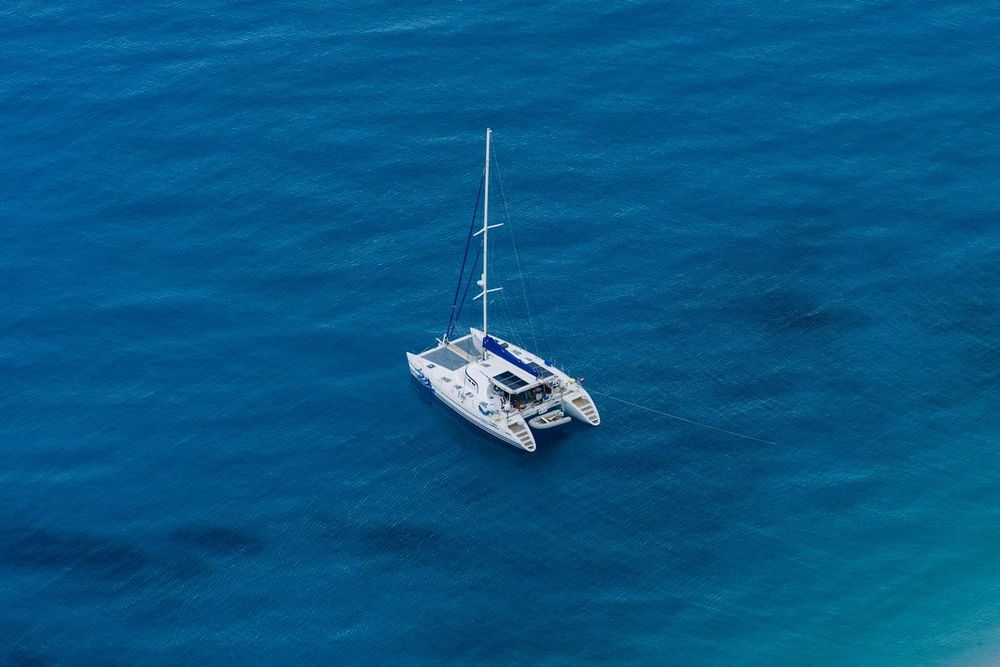
Our base case is a used 50-to-52-foot performance cruising cat — Outremer 45/51, Catana 50, HH50, or maybe an older Lagoon 500 if I lose my conviction about daggerboards. The realistic acquisition range for a sound, well-equipped boat in that class today is $900K to $1.6M. A 2014 Outremer 49 in La Grande-Motte just listed at $895K and needs another $80–120K to be ready for an Atlantic crossing. A 2018 HH50 with Code 0, watermaker, and Starlink Maritime already installed will run $1.3M and up.
Pick the wrong starting boat in your spreadsheet and every other line item breaks.
Depreciation and refit reserve are not the same thing
Cruisers love to point out that a well-loved cat doesn't really depreciate the way a powerboat does. That's mostly true. But it's separate from the question of how much money the boat eats every year just to stay the same boat.
I budget refit reserve at 3.5% of hull value per year. On a $1.3M boat that's $45,500 a year — and that's the number I'd actually expect to spend over a long average, not a contingency on top. New rigging at year ten ($30–60K). Sails on a 6–8 year cycle ($50–80K to redo the working wardrobe). Two saildrives or shaft seals every five to seven years. House battery bank refresh ($15–30K every eight years for lithium). Watermaker membranes. Anchor windlass rebuild. The dinghy and outboard, which on the strict accounting are a separate boat that depreciates fast and gets stolen occasionally.
People who've owned a cruising cat for more than five years tell me 4% is more honest. I'm using 3.5% only because I plan to do a lot of the simpler maintenance myself. If you're going to pay yard rates for everything, build the spreadsheet at 4.5% and don't argue with the math when it stings.
Insurance is the line item that's gotten brutal
Five years ago you could insure a cruising cat for an Atlantic circumnavigation for around 1.2–1.5% of hull value. Today, with most underwriters either pulling out of named-storm zones or piling on conditions, I'm seeing real quotes at 2.0–2.8% for an experienced couple. For a young family with relatively modest offshore miles before departure, expect the higher end and a substantial named-storm exclusion.
On a $1.3M boat that's $26K to $36K a year. And that assumes you stay outside the Caribbean hurricane belt during the season — fine for an east-to-west circumnavigation, harder if you want to hang around the Eastern Caribbean.
I've quoted with Pantaenius, Topsail, and Markel through a couple of US-based brokers. The differences are real but smaller than people promise. The bigger lever is your stated cruising area and your crew CV. A spouse with documented offshore deliveries and a couple of ARC or Pacific Cup miles drops your premium meaningfully more than a half-point of hull value will.
Living costs get weird offshore
Once you're moving, the day-to-day cost picture changes more than I expected. Food is your largest ongoing variable, and it has nothing to do with the boat. Feeding a family of six in French Polynesia is not the same exercise as feeding them in Grenada. Our base assumption is $2,800/month averaged across the trip, with French Polynesia and remote Indonesia running closer to $4,000 and Mexico/Panama coming in under $2,000.
Marina nights are where most cruisers either save fortunes or hemorrhage them. We're planning on roughly 70 nights/year at the dock — partly because four kids want hot showers, partly because boat work is easier with shore power — and budgeting an average of $1.50/foot. That's $5,250/year, which sounds low until you remember that 295 nights of the year we are anchored for free.
Fuel is small for a sailing boat used like a sailing boat. We expect 250–350 gallons a year of diesel, mostly for charging in calm anchorages and short hops between islands. Call it $1,800/year at average global prices, more if half the trip is in Europe or Australia.
Communications is the one cost that has actually gotten better. Starlink Maritime at the global plan is $250/month with a one-time $2,500 hardware buy-in. I'm carrying an Iridium GO! Exec as backup for $135/month and a real PredictWind subscription at the offshore tier. Total comms: about $5,200/year for redundant connectivity that would have cost three times that five years ago.
The shore-side costs nobody warns you about
Here's where most cruising budgets get blown up. You don't stop having a life ashore just because you're on a boat.
Healthcare for six is the one I lost the most sleep over. A reasonable international family policy with US-quality network access runs $22K to $32K/year, depending on deductible and the kids' ages. We landed on a Cigna Global plan with a high deductible and a separate emergency-evacuation rider through DAN Boater for around $28K all-in. That's not negotiable, and it goes up every year.
Schooling for four kids, two of whom will be middle-school age for most of the trip, is harder to budget than I expected. Calvert Education for the younger two, and a hybrid Time4Learning plus an outsourced math tutor on Zoom for the older two — call it $6,000/year all-in, plus a few thousand more for materials, books, and the occasional in-person class on shore. Cheaper than the US private-school number we'd otherwise be paying. Hugely more work for the parents.
Storage in the US for everything we couldn't sell or talk ourselves into not needing: $310/month, or $3,720/year. This is real and it's a five-year line item.
Flights home for six humans, twice over five years (a wedding, a funeral, the things you can't predict): I'm reserving $15K total, which I think is light.
Taxes and accounting continue regardless of latitude. I'll need a CPA who actually understands the foreign earned income exclusion and the state-residency mess of leaving Oregon without truly leaving Oregon. Add $3,500/year.
The honest annual operating number
Pulled together for a 50-foot cat on a five-year circumnavigation with a family of six:
- Insurance: $30,000
- Refit reserve / maintenance: $45,000
- Food: $34,000
- Marina nights: $5,000
- Fuel: $2,000
- Comms: $5,000
- Healthcare: $28,000
- Schooling: $6,000
- US storage: $4,000
- Travel home reserve: $3,000
- Taxes and accounting: $3,500
- Discretionary / contingency: $25,000
That's $190,500/year in operating costs. Round it to $200K to be honest about how often you'll go over.
Over five years, before the boat itself: $1.0M.
The boat number on top of that
Now add the boat. If we buy used at $1.3M and finance half at current rates, the carry alone is roughly $32K/year for the financed portion — call it another $160K over five years in interest before resale. If we sell at the end for $1.1M (normal cat depreciation curve, plus a refit), the actual capital cost of ownership over five years lands somewhere in the range of $300K to $400K depending on what the market does.
Add it up: $1.3M to $1.4M all-in for a five-year family circumnavigation done well, on a 50-foot cat, with four kids in school, real healthcare, and real comms.
That's why "you can cruise on $50K a year" is technically true and also a lie. Different boat. Different family. Different decade.
Why I'm sharing the actual number
I'm sharing this for two reasons. First, the people I'm in conversation with about going cruising — the ones in my actual life, not on a forum — keep getting quoted numbers from the internet that are designed to sound encouraging, not honest. If you're underwriting your family's safety and education on those numbers, that is not a kindness.
Second, and more selfish: when you put a real budget down on paper and stress-test it, you find out which assumptions actually drive the outcome. For us it's two — the boat we buy, and the healthcare plan. Everything else moves the bottom line by 10%; those two move it by 50%. So those are the two I'm spending the most time getting right before we close on a hull.
The rest is a question of when the kids are the right age, when the boat we want is on the market at the right price, and whether we're brave enough to actually pull the trigger.
I'll let you know.