The Jordan Series Drogue bridle math I keep redoing for a 50-foot cat
On a monohull the JSD is solved physics. On a cat you have two transoms, two snatch loads, and a bridle geometry nobody quite agrees on.
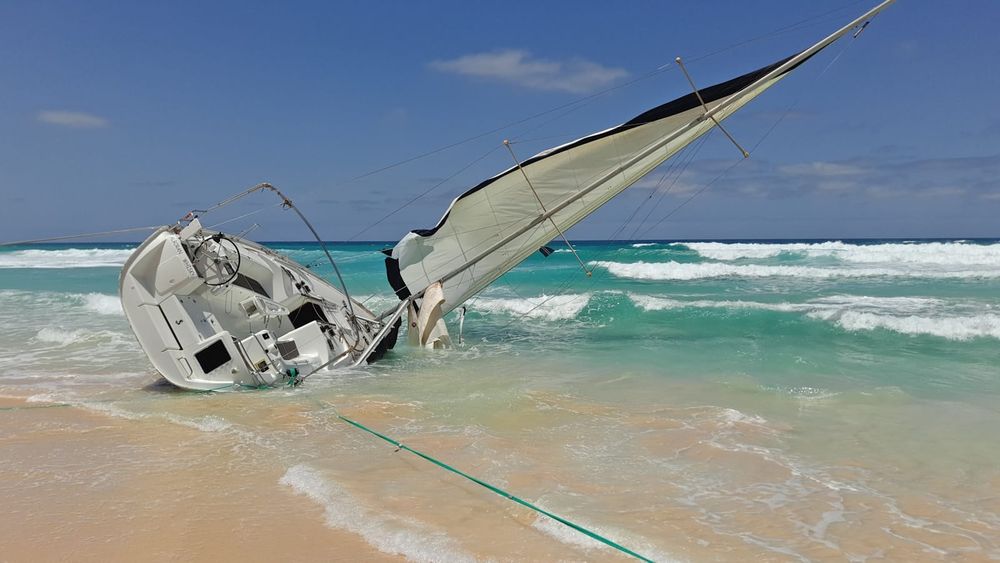
Storm tactics on a cat aren't a smaller version of storm tactics on a mono. That's the part I keep coming back to.
I went down the Jordan Series Drogue rabbit hole again this week — Don Jordan's design, a tapered series of 5-inch cones spliced into a long rode, deployed off the stern to absorb wave impact through distributed drag instead of a single point. On a 12-tonne monohull it's 113 cones. The math is settled. Skip Allen will tell you a JSD saved Wildflower in conditions that probably should have ended her. The Drag Device Database has the field data.
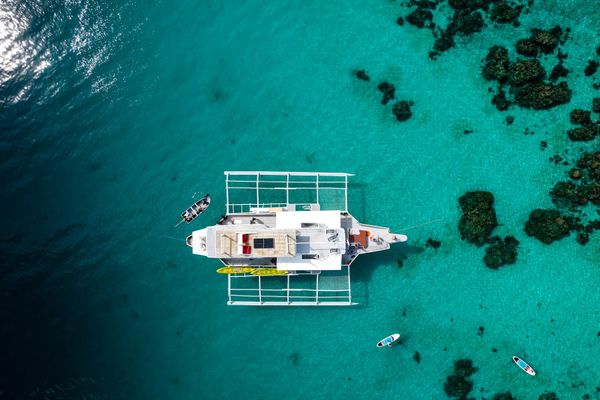
But the 50-foot cat we're researching is going to be 13–15 tonnes with two transoms 25 feet apart, and JSD on a cat is not the same question. You need a bridle. The bridle is two legs running from each stern attachment point back to a single shackle where the rode begins. Sounds simple. Isn't.
Each leg should be 1.5–2x the beam to share load when the boat yaws — call it 35–50 feet per side. That's a lot of rope on deck before you even count the rode. And the bridle has to be sized for peak shock load, not steady load. JSD loads on a 12-tonne boat spike to 2–3x displacement in a single breaking wave. On a 14-tonne cat that's 30–40 tonnes at the bridle apex.
Which is where the chainplate question starts. Transom corner padeyes on most production cats — Lagoon, FP, even some Outremers — are sized for towing or stern anchoring, not 20-tonne snatch loads through a Spectra bridle. Some boats have proper through-bolted, backing-plated padeyes. Many don't. Retrofitting one on a balsa-cored transom is not a weekend job.
Then the secondary question, which I think nobody quite answers: do you deploy bow-first or stern-first on a cat? On a mono the answer is stern — the boat surfs down the wave face and the drogue pulls from astern. On a cat with high freeboard, wide bridge deck, and zero keel resistance, the failure mode is different. Some skippers prefer lying to a para-anchor off the bow — a Para-Tech 18-footer holding the boat at 30 degrees off the wind. Charlie Doane writes about this. The Dashews preferred active steering at speed over any passive tactic, but their boats were 80 feet and not made of glass and balsa.
Where I'm landing for now: JSD off two stern padeyes, 50-foot Dyneema bridle legs, 113 cones, 350 feet of 1-inch double-braid rode — the Jordan-canonical answer. About $4,800 in gear plus the padeye install. A 12-foot Para-Tech sea anchor off the bow with 400 feet of nylon rode and a proper swivel is about $2,400 and demands different boat handling. Both is $7,200 and 200-plus pounds of gear that lives in lockers for ten years and gets deployed twice.
I'm leaning JSD, mostly because the failure mode of a drogue (boat yaws, bridle loads unevenly) is something I can mitigate with rigging. The failure mode of a para-anchor in a cross-sea (boat lying broadside, getting rolled) isn't. The asymmetry favors the gear I can engineer my way out of.
But I haven't actually talked to anyone who's deployed either off a 50-foot cat in survival conditions. That's the next call. If you have and you're reading this — message me through the worksheet.