Year one of cruising will cost our family of six about $174,000. Here's every line.
I priced our first year on a 50-foot cat for a family of six line by line. The number keeps coming out to $174,000 — and the spread between honest budgets and forum fantasy is wider than people think.
The "10% of hull value per year" rule is the most repeated number in cruising and it's almost useless for a family. It's a rough proxy for what an owner-couple spends keeping a mid-size monohull off the rocks. Drop four kids onto a 50-foot performance catamaran, push offshore, and the line items change so much that the answer stops fitting on a bar napkin.
I priced our first year line by line. Not the boat — the year on the boat. The number I keep arriving at, with what feels like honest reserves and no charter-life delusions, is $174,000. Some of that is fixed and brutal. Some of it is the kind of money that disappears in the marina office before you even finish your espresso. And a meaningful slice is offset by what we stop spending the moment we cast off.
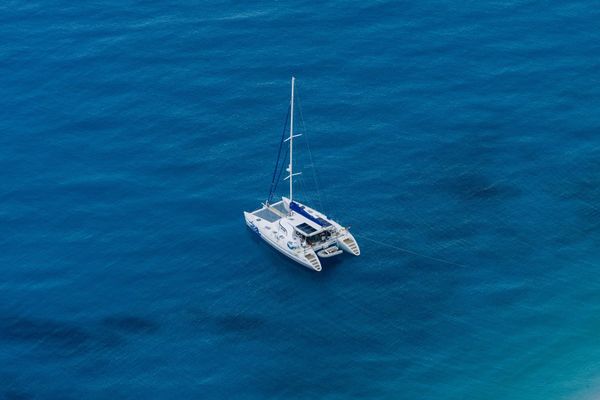
Here's how it actually breaks down, on a 2018-ish Outremer 51 hypothetical (insured value around $1.05M, the boat we keep coming back to in the 47-point worksheet), departing the U.S. East Coast in late summer, working south through the Caribbean and into the Eastern Pacific by spring.
Insurance is the line that ruins most spreadsheets
If you're shopping a 50-foot cat with two kids under five aboard for an offshore policy, you're going to talk to maybe four underwriters who don't laugh at the application. We've been through the exercise. Markel, Pantaenius, and a couple of Lloyd's syndicates via Topsail are the realistic conversations. The number for a $1M hull, named-storm coverage limited to the Eastern Caribbean below 12°N during hurricane season, with a captain endorsement and a family of six aboard: $31,000 to $44,000 for the year. We're modeling $38,000.
That's not a typo. It's also not the worst it gets. Try the same boat with a planned South Pacific crossing and the Caribbean season extended above 12°N and you're north of $50K fast. The way you actually buy that number down is with track record — a documented offshore passage with a delivery captain or instructor for the first 1,000 miles — and the family circumstance is, frankly, neutral to slightly negative. Underwriters don't love the optics of small kids on a long passage, even if statistically a well-prepared family is lower-risk than a charter boat full of strangers.
Anyone who tells you they're insuring a 50-foot offshore cat for $12K has either a different boat, a different ocean, or a policy that won't pay when something actually happens. The exclusions on the cheap quotes are where the money is.
Maintenance reserve: the number we argue about most
This is where the "10%" rule originates and it's the line I push back on hardest. On the Outremer specifically — a boat built reasonably well, with carbon mast, daggerboards, and a lot of composite systems — 10% of a $1.05M hull is $105K of annual maintenance reserve. That's nonsense for year one if you bought the boat in survey-ready condition.
What you actually spend, year one, on a boat you bought right, is closer to $28,000 to $42,000. We're budgeting $36,000. That's a 3.4% reserve, and here's what it has to cover:
- Annual haul-out, bottom paint, propeller service, anode replacement: $4,500–$7,000
- Rigging inspection (year one is the baseline) and any quiet adjustments: $1,500–$3,000
- Engine services on both saildrives, oil/filters/impellers/zinc on the gensets: $1,800–$2,800
- Sail repairs and one new headsail UV cover: $1,200–$3,500
- Watermaker membrane service and pre-filters: $400–$900
- Standing rigging, running rigging chafe replacements: $1,500–$4,000
- Electronics quirks (something will fail, usually the autopilot drive or a B&G triton): $1,500–$5,000
- Outboard service, dinghy patch, oars: $400–$1,200
- The "I don't know what this is yet" line: $8,000–$12,000
That last line is the honest one. Year one finds the squeaks. You replace what the previous owner deferred. The Catana, Lagoon, and Fountaine Pajot owners I've talked to all roughly agree: you spend more in year one than year two, and almost everyone underbudgets the first year by about a third.
If the survey turned up anything serious — saildrive seals, a soft deck, sail age — that comes out of capex, not this line. Don't roll it in.
Provisioning a family of six is its own category
Food for two adults and four kids — currently ages five, four, two, and one in our planning — runs differently than food for a couple. We're not eating ashore most nights. We can't realistically expect kids to live on rice and lentils, even if we're trying to skew that way. And the protein math is the dominant variable.
Realistic provisioning, including ashore meals once or twice a week, fresh-food top-ups in port, and a quarterly bulk run at a U.S.-priced grocer when geography allows: $2,400 to $3,200 per month. We're modeling $32,400 for the year, or about $2,700 a month average. That assumes about 60% of nights at anchor cooking aboard, 25% in marinas with mixed cooking and ashore, 15% in passage mode where the food costs go down but the prep complexity goes up.
The Caribbean is where this number can blow up. A small grocer in St. Lucia charges three times Costco for the same Quaker Oats. We're building in a Puerto Rico stop specifically for a bulk reset before the windward island chain.
The line nobody likes to talk about: family health insurance
For two adults and four U.S.-citizen kids spending a year outside the U.S., your domestic ACA marketplace plan does not work the way you think it does. Most plans cover emergency care only outside the U.S., reimbursed after the fact, with documentation requirements that are punishing. So you carry expat health insurance on top of, or instead of, the U.S. plan.
GeoBlue, Cigna Global, and IMG are the three quotes worth getting. A family-of-six high-deductible expat plan with U.S. coverage included, evacuation rider, and pediatric dental: $18,000 to $26,000 a year. We're modeling $22,000.
Evacuation is the line where I get firm. A medevac out of a remote anchorage to a tertiary hospital can be $80,000–$150,000 cash. The rider that covers it is $1,200 a year. Buy the rider.
Communications, dockage, fuel, and the small lines
These are smaller individually but they add up:
- Starlink Maritime + Iridium Certus backup: $5,200/year. Starlink alone is $2,400 with the right plan; the Iridium overlay matters because Starlink coverage gaps still exist mid-ocean and you want a working sat phone for weather routing and Predictwind when the dish is down.
- Marina nights (we're planning ~45 nights at dock, 320 at anchor or underway): $8,400. Caribbean dockage is brutal in the BVIs and St. Martin, more reasonable in Grenada and Curaçao where we'll stage hurricane season.
- Diesel, propane, gasoline, water: $4,800. A 50-foot cat motoring less than 15% of the time, twin 57hp Volvos.
- Cruising permits, visas, agent fees: $2,800. Bahamas, Panama transit ($2,500 for a 50-footer alone, eye-watering), and the chain of smaller fees through the Caribbean.
- School materials, curriculum subscriptions, books: $2,400. We're going with a combination of Acellus, BFSU, and a Wildwood-style nature/journal curriculum for the younger kids. Most of it digital, but the print resources matter offshore.
- Travel home — flights for the family to visit parents twice in the year: $11,000. Six people flying from a Caribbean island back to Bend, Oregon is real money.
- Insurance deductibles and minor claims we'll likely eat: $2,000.
- Crew gifts, anchorage shore-runs, fuel for the dinghy, the random $40 cab from immigration: $3,000. Cruisers laugh at this line; it's always bigger than you think.
Add it up: $39,600 for that block.
The honest total
Insurance $38,000 + maintenance reserve $36,000 + provisioning $32,400 + expat health $22,000 + miscellaneous $39,600 = $168,000. Round up to $174,000 for the inevitable things I haven't anticipated. If you read the cruising forums, you'll see numbers from $60K to $250K thrown around for similar plans. Most of the low ones are couples on smaller boats. Most of the high ones include either a captain's salary or a charter-style provisioning habit. We're somewhere in the upper-middle of that band, and I think honest people on similar boats arrive at similar numbers.
Pricing your own year? The same worksheet I'm using to evaluate the boat itself has a budget tab that walks through these exact line items with your numbers. Open the 47-point worksheet →
What you stop spending the day you leave the dock
This is the part the budget conversations skip and it's the part that actually makes the math close.
We are not paying a mortgage on a Bend house that's rented while we're gone. Net of property management, rent covers the mortgage and a sliver of maintenance — call it neutral. We are not paying for two cars: the Subaru goes into long-term storage, the truck gets sold. Insurance and registration drop by about $4,000 a year. The kids' preschool and toddler care lines, which are real money for four small kids, go to zero — that's about $48,000 a year in central Oregon, which is a quietly shocking number when you put it on paper. Restaurants, Costco runs, the everyday consumer drift of suburban life: that's another $18,000–$25,000 a year that just doesn't happen the same way.
Net those out and the actual marginal cost of the cruising year is much closer to $80,000–$95,000 than to $174,000. Which is not nothing. But it's not the financial crater most people imagine when they hear "circumnavigation with four kids."
What changes if I'm wrong
A few things could move this number meaningfully. Insurance keeps getting harder for offshore family policies — if Markel withdraws from the segment, which they've quietly hinted at for some risk profiles, our $38K could become $52K and the Caribbean season has to shrink. A bad year-one survey discovery — saildrive seals, soft deck, an electronics retrofit — could push maintenance to $55K. And if Starlink Maritime changes its pricing again, which it has every nine months for two years, the comms line moves around.
The number I'm most likely to have underestimated is provisioning. Four kids eat more every year. If our boys hit growth spurts in year one — and the four-year-old already eats like a teenager when he wants to — that line could go to $38K without me noticing until the credit card statement.
I'd rather show my work and be wrong by 15% than quote a $90K fantasy number and tell my wife about the $174K reality from an anchorage in St. Lucia. Year-one cruising for our family is roughly the cost of two mid-tier private school tuitions in Bend. Looked at that way, the value proposition gets a lot less exotic, and the conversation with the spreadsheet stops being scary.
Next month I'll publish the capex side — the actual boat purchase and pre-departure refit budget — which is a much larger and weirder number. That one I'm still arguing about with myself.