What it actually costs to insure a $1.2M cat for a five-year circumnavigation
I asked nine underwriters to quote our family circumnavigation. The two real bids came in 71% apart — and the cheaper one was the wrong policy.
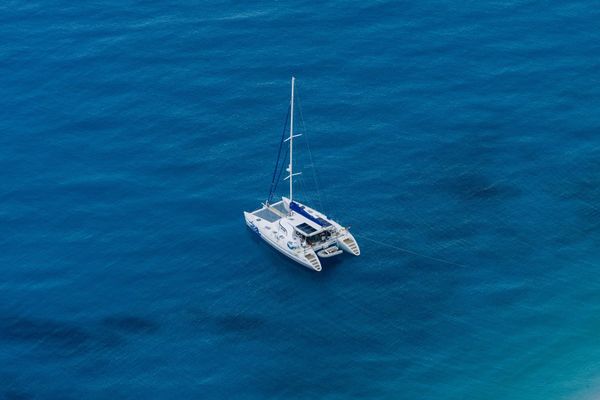
I asked nine insurers to quote a five-year family circumnavigation on a fifty-foot catamaran. Three never replied. Two declined outright. Two came back with hull-only policies and a list of exclusions that made me wonder why I was paying anything. The remaining two quoted, and the spread between them was 71%.
That spread is the actual story of yacht insurance in 2026. Not the sticker price. The spread. And it is wider than almost anyone shopping a first quote understands.
I have spent the last six weeks running this exercise as a real underwriting submission, not a curious-buyer email. Survey out of last winter, named skipper resume, a draft passage plan with annual mileage and a cruising area schedule, the full spec sheet and equipment list, prior claims history, the trust that will own the vessel. The works. What follows is what I learned, with the names attached, written in the order the lessons hit me. None of this is investment advice. It is also not legal advice. It is one wealth advisor and prospective owner trying to figure out how to put his family on a boat without losing the boat to a single bad night.
The market is smaller than the brochures suggest
If you read the trade press, you would think there are dozens of options for offshore yacht insurance. There are not. For a family of six, transiting tropical waters, planning a Pacific crossing inside three years, and overlapping at least one named-storm season in the South Pacific, the realistic underwriter list shrinks fast. In the U.S. and U.K. retail channels, you are mostly looking at Pantaenius, Topsail, Y-Yachts (through MS Amlin), Admiral Marine via Lloyd's syndicates, the Markel-backed schemes (Markel American, Jackline), and a few specialty MGAs like Yachtinsure and Edward William. Geico and Progressive and the marine arms of the U.S. carriers will write coastal U.S. and the Bahamas, occasionally the Eastern Caribbean north of Grenada, and almost nothing else.
That is the whole pond. Once you ask for blue-water language, you are inside a dozen real underwriters who genuinely understand the risk, and most of them are syndicated through the same Lloyd's box. When two brokers come back with what looks like the same policy at different prices, sometimes it is literally the same policy at different commissions. That is not a knock. It just means shopping price alone is the wrong frame.
The 71% spread, decoded
My two real quotes came in at 1.42% and 2.43% of the agreed hull value, which on a $1.2M boat is the difference between $17,040 and $29,160 a year. Annualized over five years that is a $60,600 swing, which is not nothing — that is a year of cruising kitty for our family.
It is tempting to take the cheaper number and move on. The real exercise is to read the two policy wordings side by side and figure out where the $12,000 a year is going. In my case it bought four real things, and I would pay for three of them again.
The first was the named-windstorm deductible. The cheaper policy has a 15% named-storm deductible if the boat is south of 35°N or north of 35°S during the relevant storm season for that ocean. On a $1.2M hull, that is a $180,000 first-loss number. The expensive policy has a 5% NWS deductible — a $60,000 first-loss number — and the language for "in season" is more carefully drawn around hurricane boxes that I will actually be transiting. The expensive policy also pays for the haul-and-tie down if a named storm is forecast within 72 hours of the boat's location. On a Hurricane Beryl-style year, that single endorsement pays the premium delta in one event.
The second was the cruising area. The cheap quote restricted me to "60°N to 35°S excluding any country listed by the U.S. State Department at Level 3 or 4," which is a moving target that has at various points included parts of the Bahamas, all of Venezuela, parts of Mexico, and several stops I have penciled in for the Indian Ocean leg. The expensive quote names the territories explicitly — the Bahamas, the Caribbean north and south, Panama, French Polynesia, Cook Islands, Tonga, Fiji, Vanuatu, New Caledonia, Australian east coast, Indonesia, Malaysia, Thailand, Maldives, Chagos under conditions, La Réunion, South Africa, the trade-wind Atlantic loop — and it does not move on me when the State Department updates a page. That is worth real money for a long passage plan. You do not want to cross the Indian Ocean and find your hull cover lapsed in the middle of it because of a re-classification you did not see.
The third was crew. Both policies require two adults aboard for offshore passages, but the cheaper one defines "offshore" as anything more than 50 miles from a safe harbor and requires both adults to have RYA Yachtmaster Offshore or equivalent. My partner does not, and is not going to before we leave. The expensive policy lets me satisfy the experience requirement with a documented mileage log under named skippers and an ASA 108 or RYA Coastal-plus track. That is a meaningful concession and one a broker who actually understands cruising families had to fight for in the underwriting call.
The fourth was the deductible structure on the dinghy and outboard. Honestly this is where I would not pay the premium. Both policies cover the tender at agreed value. The expensive one has a slightly lower deductible. We are talking about a $4,000 RIB and an $8,000 Yamaha. I can self-insure that risk all day. If the only difference was the dinghy line, I would buy the cheap policy and pocket the difference.
Read the navigation warranties before you read anything else
The single biggest mistake I made in my first read of these policies was treating the navigation warranty as boilerplate. It is not boilerplate. It is the policy. Everything else is decoration around the warranty.
A navigation warranty does three things at once. It tells you where you can be. It tells you when you can be there. And it tells you what happens to the policy if you violate it. In most blue-water policies the consequence is not a denied claim — it is suspension of cover for the duration of the violation. Sail through a warranted-out area on a Tuesday, hit a container Wednesday, and the underwriter's first move is to ask whether cover was suspended at the moment of the loss. The answer is usually yes. Then you are arguing about whether a reasonable cure was effected before the loss. That is a fight you do not want.
For a circumnavigation, every leg crosses a warranty boundary. The realistic sequence is: U.S. East Coast through hurricane season language, Bahamas, Caribbean with a southbound move below 12°40'N by July 1, Panama Canal with an inland-waters carve-out, Galapagos with a permits warranty, Marquesas, the Tuamotus where the cover often quietly excludes "uncharted reefs within X miles of an atoll," Tonga, then a hard southerly run to New Zealand to be south of 25°S by November 1, summer in NZ, north again, and the cycle repeats across the Indian Ocean. If your broker cannot map your draft route onto your warranty in plain English on a single page, you do not have a deal yet. You have a stack of paper.
I asked both shortlisted brokers to do this exercise. One did it inside three days with annotations on a Google Earth file. The other took two weeks and gave me a Word document with three errors I caught on first read. That, more than the price, told me who I was actually buying from.
The "depreciation on partial loss" trap
Here is one most first-time owners will never hear about because the underwriter has no incentive to volunteer it. Many cheaper offshore policies look like agreed-value hull policies until you read the partial-loss section, where the wording quietly switches to actual cash value. What this means in practice: the boat is insured for $1.2M for a total loss. Tear up the bottom on a coral head, and the carrier pays the cost to repair, less depreciation on the parts, less the deductible. A new set of saildrives, daggerboards, and a section of underwing skin can run $80,000 to $140,000. With depreciation applied to gear that is already five years old, you may be writing checks for a third of that out of pocket on top of the deductible.
The fix is to specify, in the policy schedule, which line items are agreed-value and which are not. Standing rigging, sails, electronics, propulsion, and ground tackle should all be scheduled. If your broker shrugs at this question, find a different broker.
What "offshore experience" actually buys you
Underwriters price experience harder than they price the boat. The same hull on the same plan, with a captain who has 30,000 documented offshore miles versus 3,000, can see a 30 to 40% premium difference. There is no negotiating around this — it is a structural input to the rating model.
What is negotiable is how the experience gets counted. Offshore passages under a named skipper count. Coastal mileage with a logged passage of 250+ nautical miles non-stop counts. Race miles count, including delivery legs. Deliveries on a charter or rally fleet count. Family-only weekend sailing in protected waters does not count, even if you have done a thousand of them. I am building toward 8,000 documented offshore miles before we leave, including a planned ARC+ in the year before departure, because every named-skipper passage I add lowers the rate or buys a better navigation warranty. That is a real ROI calculation I would not have made if I had not started the underwriting process two years before our planned departure.
The trust ownership question
Almost every wealth-management client I have ever worked with who buys a serious cruising boat ends up holding it inside an LLC or a revocable trust, often domiciled outside their home state for sales-tax and registration reasons. That is fine, and the carriers are used to it. But the additional named-insured language has to be written carefully. If the trust owns the boat and the underlying insureds are the spouses, the spouses need to be named insureds, not just additional insureds, or there are gaps in liability cover for any negligent act not directly attributable to the registered owner. Ask your broker to issue the binder and walk through who is covered, when, in what capacity. I have seen at least one example where a charter incident on a privately owned boat triggered a denial because the captain was a named insured but the spouse, who was operating the vessel at the moment of impact, was only an "additional insured for liability arising out of named insured's actions." That is a phrase to grep for.
This is also where the wealth advisor in me notes the obvious: an umbrella policy on shore is not going to extend over a vessel during a passage. Your shoreside personal liability coverage probably has a watercraft exclusion that kicks in at 26 feet, or 50 horsepower, or whatever the carrier wrote. The boat needs its own liability tower, separately scheduled, and most cruisers underbuy here. We are looking at $5M in marine liability, with a separate $2M umbrella that explicitly schedules the vessel and the cruising area. That costs about $1,400 a year on top of hull. It is the cheapest piece of the program and the one I would never go without.
What I am going to do
I am going with the expensive quote, with two endorsements stripped — the dinghy hull line, which I am self-insuring, and a personal-effects rider that overlapped with our umbrella. After those edits the gap closes from 71% to about 48%, which on the same $1.2M boat is a $7,800-per-year delta over the cheap policy. That is the price of a navigation warranty I can actually plan a circumnavigation around, a 5% named-storm deductible, and a broker who can read a passage plan.
The lesson I would offer any other family staring at the same exercise is to start two years before you think you need to, treat the underwriting submission like a job application, and read the navigation warranty before you look at the price. Cheap is a number. Coverage is a sentence structure. The two are not the same thing, and pretending they are is the mistake that ends circumnavigations early.
Next week I will publish the actual annotated wording I am using for the navigation warranty, with the route map laid over it. If you are in a similar position and want to compare notes, the worksheet linked below has the questions I now wish I had asked the first broker who picked up the phone.