Heave-To or Deploy a Drogue: Picking the Right Storm Tactic for Your Boat
The choice between heaving-to and streaming a drogue isn't preference. It's hull shape, sea state, and where you are in the storm cycle. Here's the working framework.
Heaving-to and streaming a drogue are not interchangeable storm tactics. Cruisers who use them as if they are tend to find out the hard way — usually around 0300 — that their boat needed the other thing. Here's the framework I work from after twenty-some years of offshore cruising and one really memorable Force 9 in the Tasman.
What heaving-to actually does
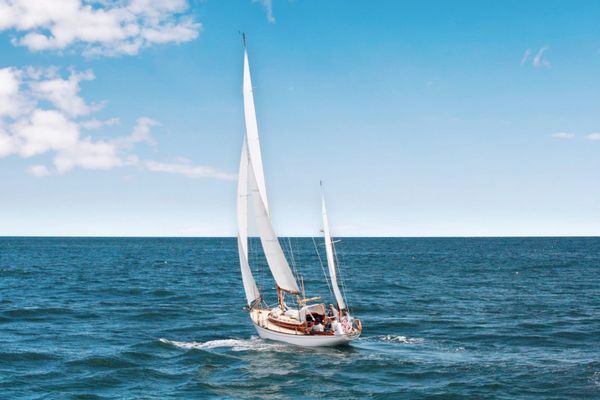
Hove-to, the boat sits roughly 50–60° off the wind with the working jib backed, the mainsail eased, and the helm lashed down (toward the wind for tiller, opposite for wheel — confirm on your boat). The boat makes very slow forward progress and significant leeway, dragging a slick of disturbed water to windward. That slick — three to five boat lengths of flattened sea — is the whole point. It absorbs breaking wave energy before the waves reach the hull.
Heaving-to works best on full-keel and modified-fin-keel boats with hull shapes that track at low speed. It works less well on fin-keel-spade-rudder modern designs because they don't track at the slow speeds heaving-to produces. They tend to lie 70–80° off the wind and slip sideways too fast for the slick to form properly.
Wind and sea limits
For a typical 35–45-foot cruising boat, heaving-to is the right call up to roughly 35–40 knots true wind, in seas that are organized — single direction, regular period. Above that, or in cross-seas where waves come from two directions, the slick stops protecting you. The boat starts getting hit by waves the slick isn't flattening, and a beam-on knockdown becomes a real possibility.
The Pardeys built their entire heaving-to philosophy around adding a parachute sea anchor off the bow to lock the boat at a tighter angle. That works. It also requires you to deploy a parachute — a different rig from a drogue — and most production cruisers don't carry one.
What a drogue actually does
A drogue (Jordan Series, Galerider, or a single cone) streams off the stern on a long rode — typically 200–300 feet of nylon. It slows the boat to 1.5–3 knots and orients the stern to the seas. The boat runs downwind, just barely. Waves break behind you, not on you. The boat cannot broach because the drogue is holding the stern.
This is the tactic for two situations: (1) wind and seas above what heaving-to can handle, and (2) you need to keep moving in a particular direction (running off downwind toward shelter or just away from a worsening system).
The Jordan Series specifically
The Jordan Series Drogue — a 200-foot rode with 100 to 150 small cones strung along it — is the gear most experienced offshore sailors recommend for boats over 35 feet. It deploys differently from a single drogue: you stream the whole thing off the stern, and the cones engage progressively as load builds. The advantage is that no single cone fails catastrophically; if one tears, the others keep working.
Cost: roughly $1,200–1,800 for a 35-footer. Storage: a sail bag's worth of bulk. Annual maintenance: rinse, inspect bridle attachments, check chafe. If you're crossing oceans, it's not optional.
The decision tree
I run this in my head before every heavy-weather forecast:
Wind under 35 knots, organized seas, full keel: heave-to. Sleep, eat, wait it out.
Wind under 35 knots, organized seas, fin keel: try heaving-to first. If she lies more than 70° off the wind and you're getting beam-on slaps, switch to drogue.
Wind 35–50 knots, seas building, any hull: drogue, run off. Heaving-to in this range is asking for a knockdown.
Wind over 50 knots: drogue. Storm trysail and storm jib if you have them. Hatches dogged. Crew off the foredeck.
Practice both
The honest truth: most cruisers practice heaving-to once and never deploy a drogue at all. That's how you find out at 0300 in 45 knots that your drogue rode is rotting in the lazarette. Run a heave-to drill every season in 18–22 knots — confirm the boat behaves the way you remember. Stream the drogue at the dock at least once so you know how to handle the bridle and the rode without it tangling.
The tactic you've actually used is the one that works.