Anchoring on Coral and Rock: Reading Holding Ground Before You Drop
Polarised glasses, the right anchor, and a chain-float trick the Tuamotus crowd has been using for decades.
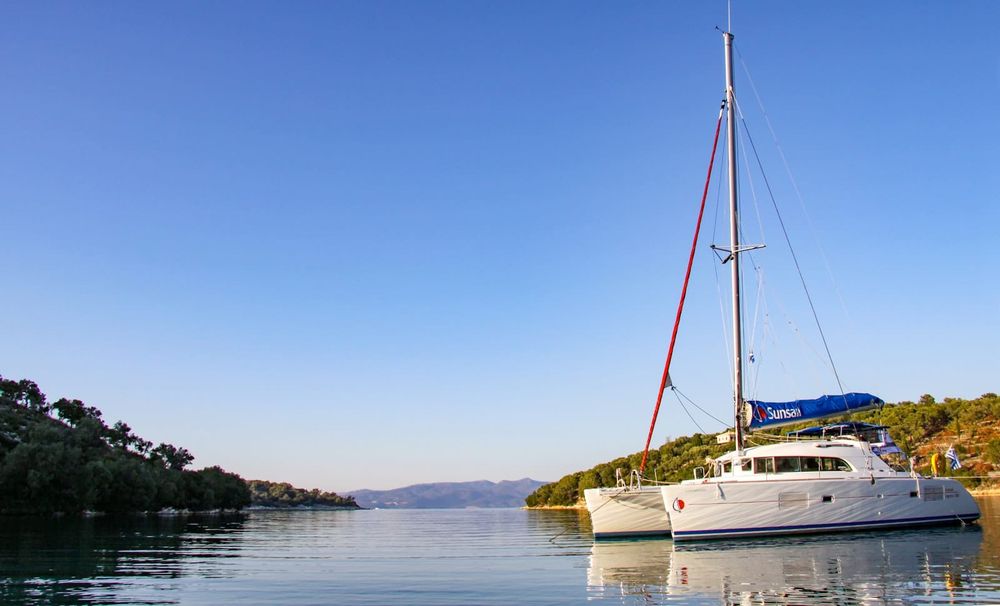
Anchoring on coral and rock is a different skill than anchoring on sand or mud. The holding ground is unforgiving, the chain sound is misleading, and the consequences of getting it wrong run from a dragging anchor at 0300 to wrapping your chain around a coral head and being unable to retrieve it without a free-dive in the morning. If you're cruising the Caribbean, the Pacific atolls, the Med, or the Florida Keys, you'll anchor on coral and rock. Doing it well is mostly about reading the bottom before the anchor goes down.
What "rock and coral" actually means
Most anchorages described as "coral" are not coral. They are sand patches surrounded by coral, or sand with scattered coral heads, or hard pan with a thin sand layer over rock. True dense coral is rare and you wouldn't anchor in it anyway. What you're really doing is finding the sand patches, dropping in them, and ensuring your chain doesn't drag across the surrounding hard ground.
Rock anchorages — Med-style — are usually limestone slab, granite, or weed-over-rock. The anchor doesn't dig. It hooks. That changes everything about how you set, how you check, and how you retrieve.
Reading the bottom before you drop
Polarised sunglasses, a pair of decent binoculars, and the sun behind you. That's the basic setup. Sand reads as light blue or beige; coral reads dark; weed reads patchy and dark; rock reads as a uniform grey-green. In tropical water with the sun overhead, sand patches are obvious from 200 metres. In Med water with the sun low, you need someone forward with binoculars calling the patch.
The depth sounder helps but it lies. A typical 50 kHz transducer averages over a wide cone — a small sand patch with surrounding coral will read as the average depth, not the sand bottom. A 200 kHz narrow-beam transducer is better. If you have a chirp transducer set to high frequency, use it. Some of the newer Garmin and Raymarine sounders show bottom hardness — coral reads "very hard," sand reads "soft." It's a useful confirmation, not a primary input.
The anchor for hard ground
Modern scoop-style anchors (Spade, Rocna, Mantus, Ultra) are excellent in sand and clay and merely adequate on rock and coral. The shape that's actually best on hard ground is older: the CQR-style plough, the fisherman, or the Bruce-style claw. The reason is that scoops need to dig. On rock, there's nothing to dig into. The anchor has to hook on a feature, and a plough or fisherman has more usable hooking surfaces than a scoop.
That said: most cruisers won't carry two primary anchors, and the Spade-style scoop is so much better in sand (which is most of what you'll anchor in) that the right answer is to keep the scoop and learn to set it carefully on hard ground. Drop, drift back to lay the chain, then power-set in steps — one short reverse pull at idle, check, another at 1500 rpm, check, then full setting at 2000 rpm. Don't slam the throttle. On rock, slamming the throttle drags the anchor across the surface and ruins the set.
Chain on coral
This is what costs people anchors. The chain is dragged across coral heads as the boat swings. By morning, you've wrapped twice around a coral head 6 metres out, the chain is locked, and your anchor is fine — but you can't get it back without snorkelling.
The fix is a float-and-line system. Tie a small fender or polypropylene float to the chain at intervals (every 5 metres for the first 15-20 metres after the anchor) using webbing or thin line. The floats lift the chain off the bottom between coral heads. Your set is unaffected because the anchor itself still buries. The chain only catches the floats, not the heads.
Float-line is standard practice in the Tuamotus and increasingly in the BVI. If you don't have floats, accept that you may need to dive in the morning. Carry a mask, fins, and a sharp knife, and don't anchor anywhere you can't free-dive to in 6 metres.
Setting on weed-over-rock
Med anchorages with poseidonia weed over rock are the hardest holding ground a cruiser sees. The anchor sits on top of the weed, the chain rattles on the rock underneath, and the first 15-knot squall sets you off. The technique that works: search for sand patches inside the weed (they're there, usually 3-5 metres across), drop the anchor onto the sand patch with very short scope, and pay out chain only after you've felt the anchor bite through the boat going stern-into-the-tug.
If there are no sand patches, don't anchor. Pick up a mooring or move on. Anchoring on solid weed in a good blow is how boats end up on rocks at 0400.