High-Latitude Routing: What the Vendée Arctique Fleet Will Teach You
The Vendée Arctique routing problem scales straight down to anyone planning an Iceland or Greenland passage this summer.
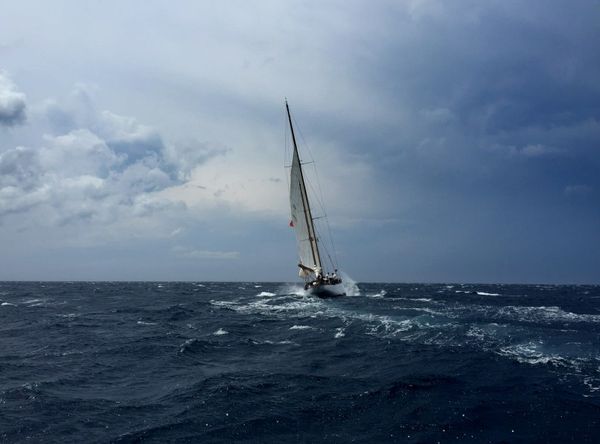
The 2026 Vendée Arctique fleet starts from Les Sables-d'Olonne in late June, and the routing problem the IMOCA skippers face this edition is one that scales straight down to anyone planning a high-latitude offshore passage. The race goes north toward Iceland and back — roughly 3,500 miles of upwind and reaching in the kind of frontal conditions that make Atlantic-crossing skippers nervous, and that make North Sea skippers shrug.
The high-latitude routing problem
The North Atlantic in June is not a benign place. The Icelandic Low has weakened from its winter peak but it's still active, and the fronts coming off it move at 25-35 knots ground speed. That means the routing decisions are made every 6 hours, not every 24, and the cost of getting it wrong is being parked on the wrong side of a front for 36-48 hours while the leaders extend.
What the IMOCA fleet does — and what cruising sailors going to Iceland or Greenland should copy — is run two routing models in parallel and look for divergence. ECMWF and GFS will agree on the synoptic picture 4 days out. They'll often disagree on the timing of a frontal passage 18-36 hours out. When they disagree, that's the decision-point. You're now choosing between routing A (ECMWF says front passes at 0400, you tack south early) and routing B (GFS says front passes at 0900, you can hold north through one more sched).
The decision rule that works: when the models disagree on timing, go with the model that has been most accurate for the last 48 hours. Save the deterministic outputs every 6 hours, then verify against the actual wind shifts you observed. By day 4 of any passage you should know which model is overcooking the front speeds for that particular weather pattern.
What changes north of 50°N
Three things behave differently up north and they all bite the unprepared. First, sea state lags wind by less than you're used to. In trades, you can have 25 knots running over a sea state that hasn't built yet. In the North Atlantic in a deepening low, the sea is already there when the wind arrives, and it builds fast. A 4m short-period sea on a beam reach in 30 knots will stop a 40-foot cruiser cold.
Second, the cold matters mechanically. Hydraulic fluid in autopilot rams thickens below 5°C ambient, and in deck-stepped rams that have a big surface area exposed to spray, you'll see it. The fix is to run a 5w-30 grade or a marine-rated cold-weather fluid (Castrol HySpin AWS-32 is the workhorse), and to check the breather isn't iced up. The IMOCA boats run heated ram enclosures — you don't need that, but you do need to know what your autopilot does at 3°C with 40 knots over the deck.
Third, sail crossover ranges shift. The kite that flies happily in 20 knots of trades will spin you out at 20 knots in 5°C air, because the air is denser. The rule of thumb is to come down one sail combination earlier than the polars suggest, until you've calibrated for the air density. Most polars are run at 15°C reference conditions; at 5°C you're carrying about 4% more apparent power for the same true wind speed.
Communications and EPIRBs
For anyone going north this summer, the comms stack matters more than in tropical sailing. The Iridium constellation is still the only one with reliable polar coverage. Starlink Maritime is available north of 60°N now in some service areas but coverage gaps still exist near the poles, and the dish doesn't track well in heavy heel angles in cold conditions — the heater can't keep up if the dish is partially submerged in spray.
Carry an Iridium GO! Exec or a Certus terminal as primary, Starlink as secondary, and an EPIRB plus PLB per crew member. Test the PLBs against an Iridium beacon test before departure — older McMurdo PLBs with batteries past their service date have failed cold-soak tests at 0°C in the past two years. New batteries cost €120. Replace them.
The IMOCA Arctique skippers will be reporting back what worked and what didn't through July. If you've got a North Atlantic passage planned this summer, watch their tracker and read the post-race debriefs. They're racing, but the lessons translate directly.