Anchoring Over Coral: Responsible Practices for Tropical Cruisers

Cruising into tropical waters usually means dropping the hook over coral at some point. It shouldn't, and in increasingly many places it isn't even legal — but the realities of protecting fragile reefs while also holding your boat safely in gusty anchorages require skills that rarely get taught outside experienced cruising circles. Here is how responsible bluewater sailors handle anchoring in and around coral.
The Non-Negotiable First Rule: Read the Bottom
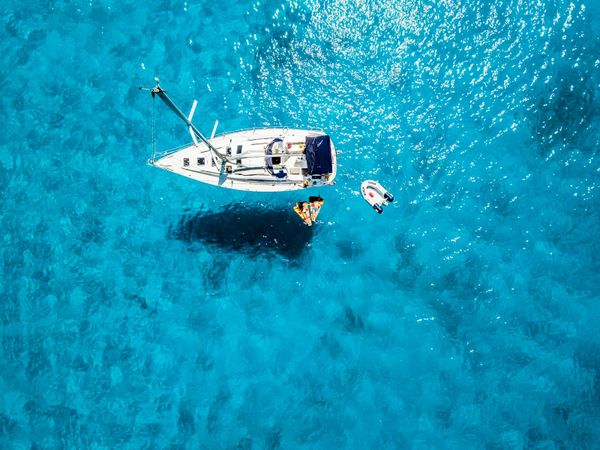
Before the anchor goes down, the bottom must be identified. In clear water this is straightforward — approach in full daylight with the sun behind you, polarized sunglasses on, and have a crew member on the bow calling out the bottom as you motor slowly through the anchorage. Sand looks white or pale gold. Seagrass looks like a shag carpet, dark and patchy. Coral heads look darker, often with three-dimensional structure that casts shadows, and in healthy reef systems you'll see the corals as distinct bumps rather than a continuous field.
You must not anchor on coral. Period. Even touching a dropped chain across a living coral head will crush polyps that can take decades to regrow, and dragging a 40kg Rocna through a bommie destroys reef that was centuries in the making. Look for clear sand patches of at least the length of your swing circle — boat length plus five times the chain length — between coral heads.
Use a Mooring When You Can
Marine parks from French Polynesia to the Red Sea are increasingly installing free or low-cost mooring buoys specifically to keep anchors off reef. In the BVI, Grenadines, Great Barrier Reef, and much of the South Pacific, the mooring network is now dense enough that there is usually an option within a short tender trip. Use them. Pay the fee. Inspect the pendant and shackle before trusting it, and don't hesitate to move if the hardware looks suspect — a parting pendant in a 30 knot squall puts your boat on the beach just as effectively as a dragging anchor.
When You Must Anchor: Technique Matters
Having found a sand patch, approach upwind in slow reverse once the bow is over the target. Let the anchor fall freely to avoid piling chain on top of it, then back down with 5 to 10 meters of chain and pause to let the anchor settle. Continue easing chain as the boat drifts back. A proper 5:1 scope (7:1 in heavy conditions) is the floor — shallower than that, the anchor's shank will lift and the flukes may not hold.
The bigger issue in coral anchorages is chain wrapping. Tidal swings and wind shifts will walk your chain back and forth across the bottom. In a field of coral heads, a 30-foot swing becomes a catastrophe: your chain wraps a bommie, your scope shortens to 2:1, and the next gust extracts the anchor and you drag. Two tools prevent this.
The first is a chain snubber on a float system — sometimes called a chain buoying rig. Tie fenders to the chain at 5 and 10 meter intervals so the middle section of the chain floats above coral heads rather than dragging across them. Many cruisers use simple closed-cell foam buoys lashed with a rolling hitch. This keeps chain off the reef and is standard practice in many South Pacific anchorages.
The second is scope management. In a tight anchorage surrounded by bommies, consider the higher-holding CQR or Mantus on shorter scope rather than a general-purpose Rocna on long scope. Tradeoffs matter here.
Setting with a Mask
In clear tropical water, the final step is always to dive on the anchor once it's set. Put on a mask and fins, swim down, and confirm: is the anchor dug in? Is the chain running clear of coral? Is there a bommie in your swing circle that needs addressing? Five minutes of snorkeling save a shredded keel. Many cruisers also carry a small GoPro on a boat hook for those cases when the anchorage is deep or the current is strong.
Final Thoughts
Every cruiser who visits a coral system is a steward of that system for the next boat. The cruising community has fought hard to keep anchorages open in places like the Tuamotus and Marquesas, and those privileges depend on us not trashing the reef we came to see. Take the extra 20 minutes, use the moorings, float your chain, dive on your hook.