The brochure says 2.7 tonnes of payload. Our family's gear list says 3.35.
I added up what a family of six actually puts on a 50-foot cat and got 3,350 kg. The Outremer 51 I like best is rated for 2,700. Here's how I'm dealing with the gap.
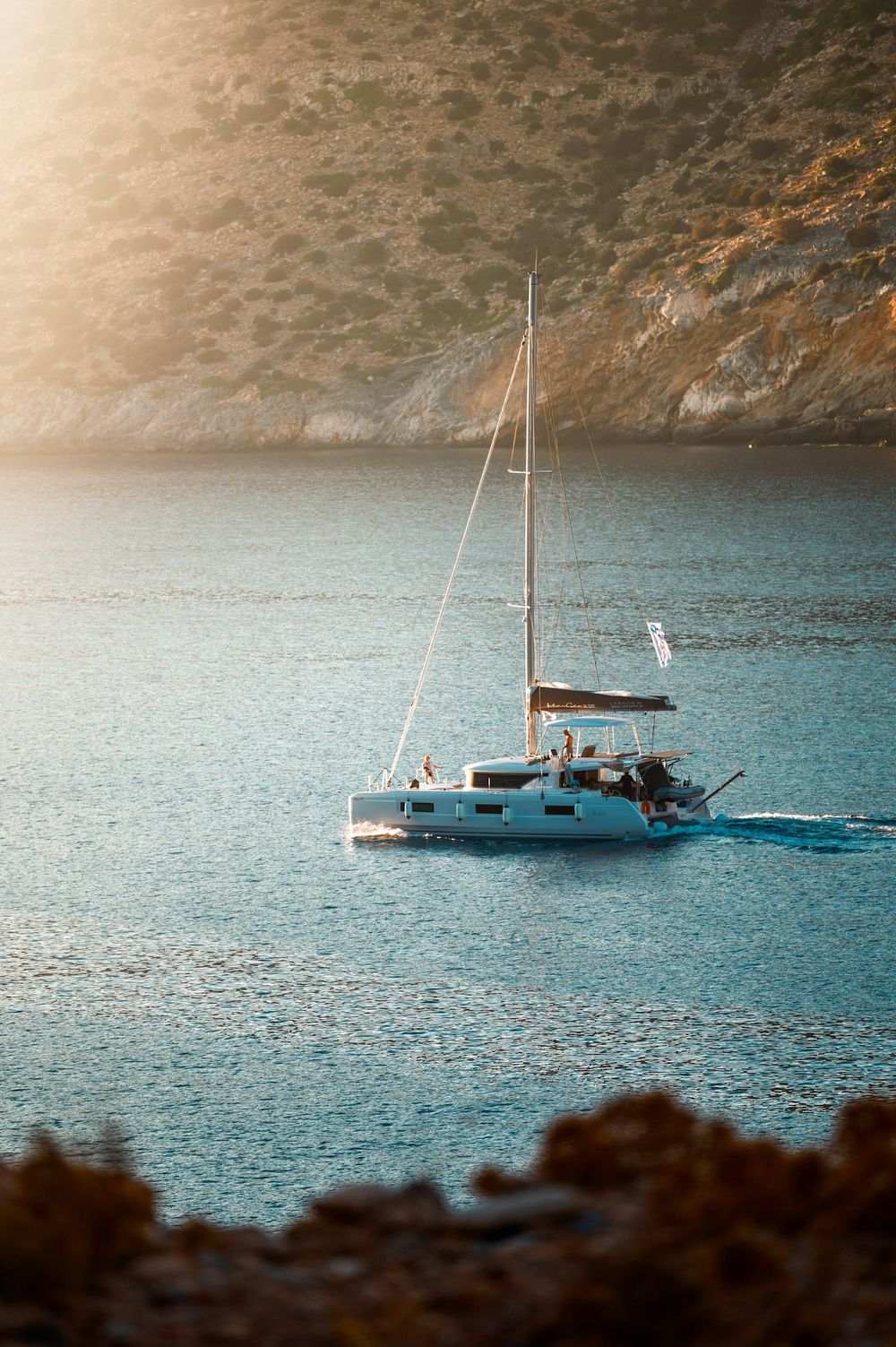
My gear list for a five-year family circumnavigation weighs 3,350 kg. The Outremer 51 I keep coming back to is rated to carry 2,700 kg of payload. That is a 650 kg gap, and it exists before I have bought a boat, signed a contract, or loaded a single case of canned tomatoes.
I've been through the spec sheets for most of the 50-footers on our shortlist, and almost none of them lead with payload. They lead with length, beam, berths, and a light displacement figure that belongs to a boat nobody will ever sail. This post is about the number that matters more than any of those, and about how I'm building it into the way I rank boats.
The two numbers on the spec sheet
Published specs for the Outremer 51 give 11,000 kg light and 13,700 kg loaded, with 51 ft 4 in length overall, 24 ft 5 in beam, and 7 ft 8 in draft with the daggerboards down. The difference is 2,700 kg, or about 5,950 lb. That is the builder's idea of what you can put aboard. Figures shift a little between years and configurations, so treat the numbers as the right order of magnitude rather than gospel, and ask the builder for the weight certificate on the actual hull you're considering.
The Fountaine Pajot Aura 51 is a different philosophy entirely. Yachting World lists it at 18,100 kg and doesn't split light from loaded, with a 26 ft 6 in beam and 4 ft 4 in draft. That is more than 4,000 kg heavier than the Outremer even with the Outremer fully loaded. The Aura sails to a different brief: a big, comfortable liveaboard that owners report cruising at 8 to 10 knots, not a boat built to stay light.
Neither number is wrong. They answer different questions. What I want to know is how much of the boat's carrying capacity my family uses, because a catamaran punishes overload in ways a monohull simply does not.
The list I actually built
I sat down with a spreadsheet and a pessimistic attitude and weighed what four kids, two adults, and three years between easy haul-outs would really put on board. These are my estimates, rounded, for a 50-foot cat leaving the Pacific side of Panama with full tanks:
- Fresh water, 600 L full: 600 kg
- Diesel, 400 L full: about 340 kg
- Provisions for 90 days, six people: about 540 kg
- Ground tackle, one 88 lb (40 kg) anchor plus 100 m of 10 mm chain, plus a spare anchor and rode: about 290 kg
- Dinghy, 15 hp outboard, and davit load: about 250 kg
- Lithium bank, watermaker, extra solar, Starlink gear: about 400 kg
- Spares, tools, books, charts and the boxes of things you swear you'll need: about 300 kg
- Safety gear, liferaft, Jordan Series Drogue, grab bags: about 110 kg
- People: about 220 kg (two adults, four kids under five)
- Toys, clothing, bedding, school supplies, the things children accumulate: about 300 kg
The total is 3,350 kg. I'd call that conservative. It does not include a second dinghy, a kayak or paddleboards, a spare sail locker, or the water you carry in jerry cans for a long passage because the watermaker failed once and you remember it. And it assumes I resist the drift that every cruising boat shows in year two, where the stuff only ever goes one direction.
The ground tackle line deserves its own sentence. Chain is the single densest thing on the bows, and it sits at the worst possible place to carry weight. 100 m of 10 mm chain is about 220 kg at the very front of a boat that wants to lift its bows into a head sea. That's a decision I'm working through on its own, and it's why I keep looking at Rocna and Mantus sizes with a scale next to the catalog.
What 650 kg does to a bridgedeck
The reason this matters on a catamaran is bridgedeck clearance, the gap between the waterline and the underside of the structure connecting the hulls. When that gap closes, waves hit the underside of the bridgedeck, you get slamming, and the boat loses speed and comfort. One clearance guide I've leaned on gives a rule of thumb of overall length in feet times 0.7 for minimum clearance in inches, which for a 51-footer comes out to about 36 in. The same source points out that a submerged transom at a dealer's dock means six inches or more of clearance is already gone before the owner's gear arrives.
So how much clearance does a tonne cost? That depends on the waterplane area, which builders rarely publish. Here is my back-of-the-envelope for a performance cat the size of the Outremer 51. Assume each narrow hull has a waterplane of roughly 10 m². Two hulls give 20 m². Immersion per tonne of added load is 1,000 kg divided by (1,025 kg/m³ times 20 m²), which is about 0.049 m, or just under 2 in. This is my estimate with assumptions I can't verify, and a fuller-bodied cruiser with a bigger waterplane sinks less per tonne. But the shape of the answer holds.
At 2,700 kg of payload the Outremer settles roughly 5 in. At 3,350 kg it settles about 6.5 in. That extra inch and a half does not sound like much, until you remember it comes out of the clearance the designer was already counting on, in the sea state where you can least afford to lose it. The 650 kg overage is what I'd call a slow tax: nothing dramatic happens in a trade wind sail, and then you're beating into a short steep chop off Cape Agulhas and wondering why the boat is slamming.
Why the heavy boats stay heavy
Once you start doing this arithmetic, the logic of heavier cats makes more sense than their spec sheets suggest. A boat like the Aura 51 starts life heavy, with big hulls, a high bridgedeck, and a large waterplane. The same 3,350 kg of family gear is a smaller fraction of its displacement, so the penalty for overload shows up slower. You pay for that in sail area (95 m² on the Aura review figures against 129 m² upwind on the Outremer), in light-air performance, and in the dollars needed to drive and anchor a boat that weighs 18 tonnes.
Lagoon, Seawind, and Catana all sit somewhere along that spectrum, and each builder draws the line differently. The useful comparison is not light displacement against light displacement. It's the share of a boat's loaded weight that is your stuff. For the Outremer on my numbers, 3,350 kg of payload on an 11,000 kg boat is a load factor near 30 percent. On a boat that starts at 18,000 kg, the same load is under 19 percent. One has a performance edge and one has a margin, and I don't think either is the wrong answer for a family.
The trap is the third option: buying the light boat and loading it like the heavy one. That is how a 50-foot cat turns into an expensive way to hit waves.
Getting a real weight, not a brochure one
The only number I fully trust is one measured on the actual boat. Any yard with a travel lift can put load cells on the slings, and some brokers will arrange it as part of a survey haul-out if you ask early and offer to pay for it. A boat that has already done a Pacific crossing is carrying its real load, so ask the owner what was aboard when it last left the dock, and compare the waterline marks to the antifoul boot stripe. If the boot stripe is buried at the transoms, you have your answer without a scale. Surveyors see this all the time and rarely write it up unless you ask them to.
What I'm doing with it
I've added a row to our own boat comparison that does one thing: it divides my 3,350 kg gear estimate by the published payload (loaded minus light displacement) and shows the percentage. Any boat above 100 percent gets a mark against it. Any boat between 80 and 100 gets a note asking the broker for the weight certificate and the current owner's actual loaded waterline photos. A boat that comes in under 80 percent gets a closer look even if the layout isn't my first choice.
That row will move the ranking. Of the boats on our shortlist, the lightest performance cats will take a hit, and a couple of the boats I'd written off as too heavy will move up. I'm fine with that. A boat we can load to the lines without slamming is worth more to us than the two knots we'd gain on paper.
If I'm right, the first thing to change is the gear list, not the boat. Water is the easiest cut: a 600 L tank plus a good watermaker is a decision, and I could carry 300 L and make water daily. Chain is next. Every line on that list gets a weight and a reason to be there. Then I'll go back to the brokers with the number, ask for the weight certificates on the three boats I'm still serious about, and see which ones can actually carry my family and its toys without the bridgedeck complaining.