The $40,000 downwind wardrobe: what I'd actually order for our 50-foot cat
The most popular downwind sail in the ARC fleet disappointed three out of four owners who counted on it. Here's what I'd order instead, with prices.
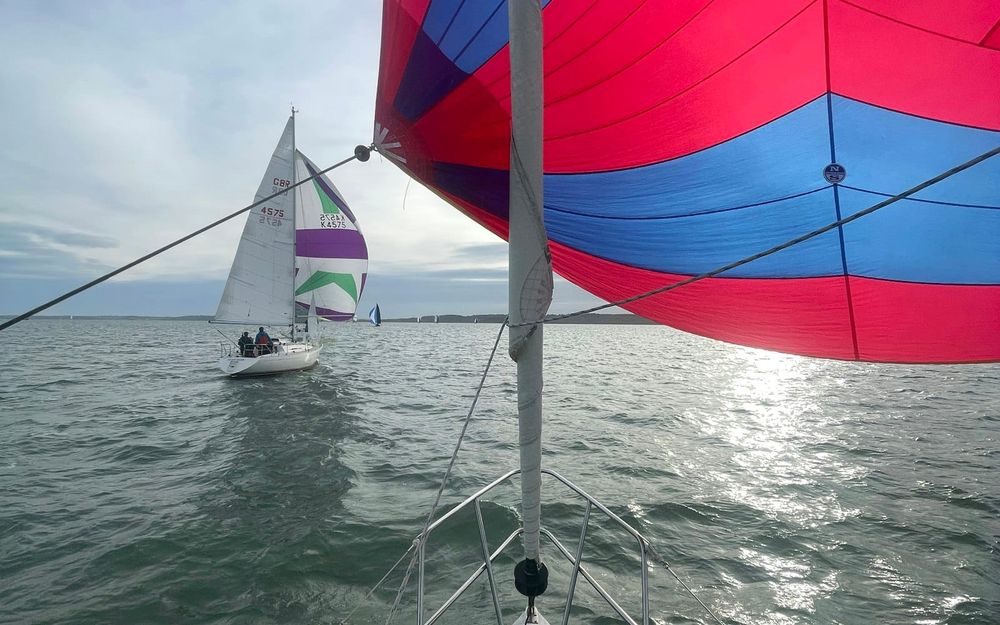
Here's a number that should bother anyone speccing a downwind inventory: in Yachting World's ARC gear survey, roughly 90 of 240 boats carried a gennaker — the single most popular offwind sail in the fleet — and only about 20 skippers rated it their most successful sailplan for the crossing. The sail everybody buys is the sail that disappointed three out of four owners who counted on it. That gap between what gets ordered at the boat show and what actually earns its keep at 165° true is the whole downwind-sail problem in one statistic.
I've been staring at this problem for our own boat. The 50-foot cat we're researching will spend the better part of five years with the wind somewhere behind the beam — Canaries to the Caribbean, Panama to the Marquesas, the long trade-wind conveyor across the South Pacific and Indian Ocean. Sail selection isn't a detail on that route. It's most of the sailing. And the sail wardrobe is a real line item: the setup I keep coming back to runs $35,000 to $45,000 before a single halyard gets replaced.
Why the most popular sail underperforms
The gennaker's problem isn't the sail, it's the geometry. Most cruising asymmetrics — especially the furling ones — are cut flat enough to reach well, which means they stall out somewhere around 150–155° true. The trades don't care. In a typical ARC year the fleet sails deep, 160–175°, for days at a time. One Grand Soleil 46LC skipper in the survey reckoned the inability to sail deep cost his crew two full days on a 2,700-mile crossing.
You can fake depth by soaking down with a deep-reefed main — two reefs lets air over the top of the mainsail and buys you 165–170° — but now you're flying less total area on the wrong sail to go slower in more comfort than the boat deserves. On a catamaran the situation is worse, because the thing blanketing your expensive gennaker is a huge square-top main on a wide-shroud-base rig that can't square out. Sheet the main for 170° on most production cats and it's lying against the diamonds and shrouds, chafing, while the headsail flogs in its shadow.
The Nautitech 44 crew in that survey said it plainly: full main and gennaker was fast but useless below 150°, and they never found a good answer for 18–24 knots of breeze — which, inconveniently, is the heart of the trade-wind range.
The catamaran-specific rules I've settled on
After a lot of reading, a lot of owner interviews, and a couple of deliveries, I've boiled cat downwind work into three rules that drive the whole inventory.
Rule one: the mainsail is optional downwind. Monohull sailors treat the main as the engine and everything else as trim. On a cat running deep, the main is mostly a chafe generator and a squall liability — you can't ease it past the swept spreaders, and getting it down in 25 knots with the boom squared is nobody's idea of fun. The best cat downwind setups fly headsails alone, or headsail-plus-deeply-reefed-main, and leave the full main for reaching.
Rule two: buy the deep sail first. The instinct is to buy the versatile reacher first because it gets used on day sails. But the trades punish that logic. The sail that matters is the one that runs 160–180° in 15–25 knots without a human standing at the helm trimming it, because on a family boat at 0300 there is no spare human.
Rule three: every sail needs a single-person douse plan. If my wife can't get it down alone while I'm asleep and four kids are asleep, it doesn't fly at night. Full stop. That one rule eliminates more sails than any performance consideration.
The four candidates, honestly weighed
Poled-out genoa / wing-on-wing. The unglamorous survey winner: around 60 boats used it, and over 40 of those skippers still called it the most reliable method afloat. It's your heavy white sail, it reefs from the cockpit, and it shrugs off squalls. On a cat you can sheet the genoa to the windward bow without a pole, which is a real structural advantage of the platform. The cost is speed — dead downwind under white sails a heavy cruising cat is a 6-knot boat in 18 knots of wind — and roll isn't the issue on two hulls, but slatting is. Verdict: this is the free option, the night option, and the backup option, but it can't be the plan.
Twin headsails. "Easy but not fast," as one Oyster 53 skipper put it. Amel builds their twin-pole system into the Super Maramu for a reason — it's superb for short-handed monohulls. On a cat the case is weaker: the wide foredeck already gives you the sheeting angles twins are designed to create, and most production cats have neither the second luff groove nor the pole hardware, so you're retrofitting $6,000–8,000 of gear to approximate what a windward-sheeted genoa mostly does for free.
The furling gennaker/screecher. Still worth carrying — just demoted to the right job. From 100° to 150° apparent it's the best sail on the boat, and on passages like Galapagos–Marquesas, where the first several hundred miles are often a beam-to-broad reach in light southeast trades, it will earn its price. A 140–160 m² furling gennaker for a 50-foot cat runs $9,000–13,000 with a decent continuous-line furler. It simply has to stop pretending to be a running sail.
The vented spinnaker — Parasailor, Wingaker, Oxley. Here's where the survey data gets loud. Forty-four boats carried one; the recurring comment from everyone else was that they wished they had. A Lagoon 450F flew theirs for 13 days and nights straight. The American crew on a Fountaine Pajot Aura 51 — a boat within spitting distance of what we're researching — logged 2,142 miles without taking their Wingaker down. The vent bleeds gusts, the wing supports the leech, and critically for a cat, it flies from the two bows with no pole and no mainsail at all, which deletes the blanketing problem and the squared-boom chafe problem in one move.
The catch is price and the douse. A vented kite in the 170–210 m² range for a 50-footer is a $20,000–28,000 sail depending on brand and size — the most expensive single sail most cruisers will ever buy. And snuffing one in a building breeze is genuinely harder than snuffing a conventional kite, because the wing wants to keep flying; more than one survey crew tore theirs hesitating in a squall. The discipline is boring and absolute: down early, down at the first sign of a squall line on radar, down before the argument about whether it's a squall line.
What I'd actually order
So here's the wardrobe I keep writing at the bottom of the worksheet, priced for a 50-foot cruising cat:
- Working jib/genoa on the forestay — comes with the boat. Recut or replace with heavier cloth before departure, ~$4,000–6,000 if replacing.
- Furling screecher/gennaker, ~150 m² — the 100–150° sail. ~$9,000–13,000 including furler.
- Vented spinnaker, ~190 m² — the 155–180° trade-wind sail, sized one notch conservative. ~$22,000–26,000 with snuffer.
- Third reef in the main — cheap insurance, ~$800 at a loft, and the survey is full of crews who wished for it.
- Two spare halyards, run and ready — the ARC fleet snapped halyards at a startling rate, and a gennaker halyard that breaks and falls inside the mast is unretrievable at sea. ~$1,200 in good double-braid.
Call it $37,000–47,000 all-in against a realistic mid-case of $40,000. That's a bruising number until you price the alternative: motoring. A cat that can't sail deep burns diesel every time the apparent wind goes soft behind the beam. At 1.5 gallons an hour per engine and $6-a-gallon fuel in the islands, 200 hours of unnecessary motoring per year is $3,600 — and five years of that, plus the engine hours, plus the misery, closes most of the gap on its own. The vented kite isn't a luxury purchase. It's the propulsion budget, spent once.
The night protocol falls straight out of the inventory: vented kite by day in settled trades under 20 knots, snuffed at dusk unless the GRIB is boringly stable; windward-sheeted genoa wing-on-wing overnight, reefed main or no main at all. Slower, yes — maybe 15 miles a night slower. Over a 3,000-mile crossing that costs us a day. Against four sleeping kids, I'll pay the day every single time.
Where this changes my boat shortlist
The uncomfortable discovery is that the sail wardrobe reaches backward into boat selection. A cat with a decent bowsprit, chainplates at the bows for kite blocks, and a big open foredeck makes this whole inventory work; a boat where the trampoline hardware fights the snuffer does not. Two boats on my shortlist just got a new worksheet line because of this piece: where do the tack points for a 190 m² vented kite actually land, and can one adult reach the snuffer line from a clipped-in position?
Next step for me is calls to two lofts — one quote on a Wingaker, one on an Istec Parasailor, both sized for the boats at the top of the list — because the sizing advice differs meaningfully between a Lagoon 50's rig and an Outremer's, and I'd rather learn that now than in Las Palmas with three weeks to departure. If I'm right about the vented kite, the most expensive sail on the boat will also be the one flying the most miles of the whole circumnavigation. If I'm wrong, I own the world's priciest sun awning. I'll report back with the quotes.