Everyone Prices the Lithium Bank. Nobody Prices the Alternator That Can Kill It
Everyone argues about cell chemistry. I keep ending up at the alternator, because that's the part that dies when the BMS does its job. Here's what I'd ask before buying any cat with lithium.
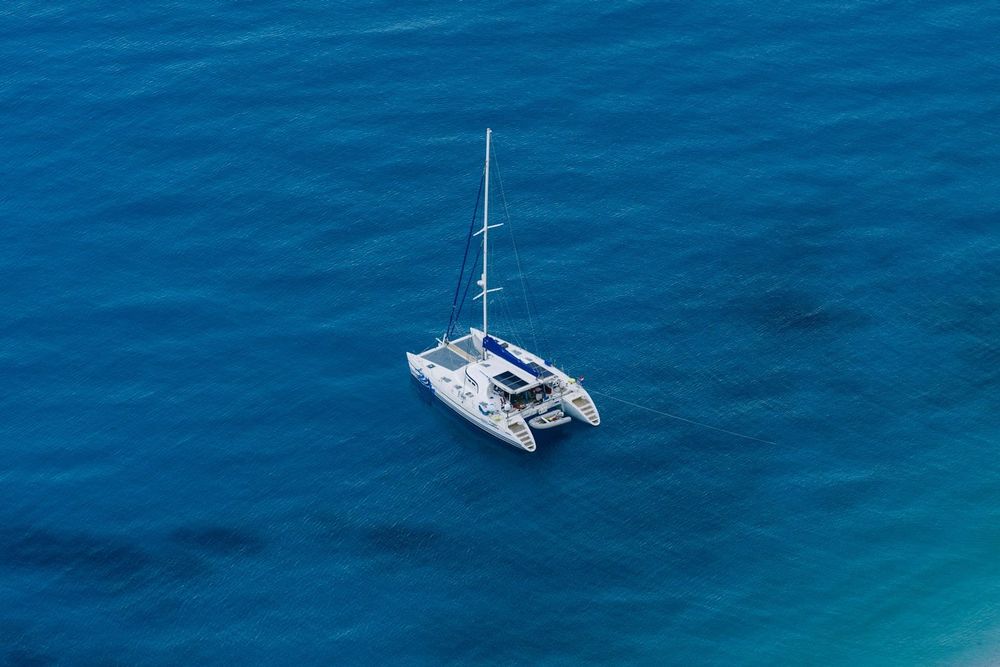
The lithium bank on the cat we're researching will cost more than the dinghy and outboard combined. The cheapest part of that system, a regulator and a few feet of control wiring, is the part most likely to fail first, and when it does it takes a $1,200 alternator with it. I've now read through enough forum post-mortems to say that with a straight face.
Everyone prices the batteries. Nobody prices the thing that sits between the engine and the batteries and decides, forty times a minute, whether the whole arrangement survives a bad afternoon off a lee shore.
The failure the brochure doesn't mention
A lead-acid bank is forgiving in a way we stop noticing. Plug a 100-amp alternator into it and the bank soaks up whatever the alternator can give, then tapers on its own as it fills. The bank is also a giant electrical shock absorber: if a load drops off or a connection gets sketchy, the batteries hold the system voltage steady.
A lithium iron phosphate bank has a battery management system, and the BMS has one job that overrides everything else: protect the cells. If a cell goes over voltage, under voltage, too hot or too cold, it opens a contactor and the bank disappears from the circuit. That's correct behaviour for the cells. But if the alternator is spinning at 2,400 rpm and pushing 90 amps at that moment, it now has nowhere to put the current. Output voltage spikes, the regulator and the rectifier diodes take the hit, and on a lot of installs the alternator is cooked before the engine alarm even registers.
That's the load-dump problem, and it's the reason a drop-in lithium swap on an otherwise unchanged 12V system is a bad idea. The batteries are fine. The things attached to them are not.
Why the old alternator setup is the wrong shape for lithium
There's a second problem that has nothing to do with disconnects. Lead-acid acceptance current falls off as the bank fills, so a typical belt-driven alternator spends most of its charging life well under its nameplate rating. Lithium doesn't taper like that. It will take close to full current from empty until it's nearly full. Put a stock small-case 100A alternator on a 400Ah lithium bank and it will run flat out for an hour or two, at engine room temperatures, and it wasn't built for that duty cycle. I'd expect a melted insulator or a belt that's been eaten down to the cord long before I'd expect a clean failure.
The fix is not exotic, and it's not cheap either. You want a regulator that talks to the BMS and also watches alternator temperature, so it can pull field current back before the case gets silly. Wakespeed's WS500 and the Balmar regulators with a temperature sensor are the usual answers. You want a belt and pulley that can handle the load, and for me the most important part, you want the BMS to warn the charge sources before it opens the contactor rather than after.
On a Victron system that's what the GX device is for. It sits in the middle, reads the battery's state, and tells the charge sources to throttle. Whichever brand you choose, the question I'd ask any seller or installer is the same: when the BMS decides to disconnect, who finds out first, the alternator or the BMS? If they can't answer, nobody has thought about it.
12V or 48V on a 50-footer
This is the argument I keep having with myself. For a family of six, the electrical loads on a cat that size are not boat-sized loads. They're house-sized loads: induction cooking, a washing machine if we find the space, a watermaker, two freezers, Starlink running 24 hours, and a lot of phones and tablets and laptops for kids who'll be doing school on board.
Here's the math that pushes me toward 48V. A 3,000-watt inverter load at 12V is 250 amps. At 48V it's about 62 amps. The first needs 4/0 cable and a lot of copper in a very short run, with every connection a place where heat can build up. The second needs cable thin enough to route through a hull without drama. A Victron MultiPlus-II 48/5000 gives you 5 kVA of inverter and a 70-amp charger in a box that one person can lift. The equivalent at 12V is either two units or one very expensive one.
The costs of 48V are real, though. Most of what's on a boat still runs on 12V, so you need DC-DC converters for the nav gear, the lighting, the autopilot pump and the VHF. Every one of those is another thing to fail. Used boats make this harder, because a 2014 cat that's been refit to lithium usually got it done one component at a time by a yard that did what the owner could afford that season. If the single-line diagram looks like a plate of spaghetti, that's what it is.
My current answer: 48V house bank, 12V for the start batteries and the critical navigation circuits, and DC-DC converters sized with real margin. I'd change my mind if the boat I end up buying has a well-documented 12V system with a proper lithium conversion already done and a drawing to prove it.
Sizing it against how we'd actually live
I built a rough daily budget for the boat, treating every number as conservative. It's not a formal load analysis, but it's close enough to argue with:
- Fridge and freezer: about 1.5 kWh/day
- Watermaker, running about two hours: about 1.0 kWh/day
- Starlink at roughly 50 W, 24 hours: about 1.2 kWh/day
- Chartplotter, instruments, autopilot, AIS: about 0.8 kWh/day
- Lights, fans, devices, laptops: about 1.5 kWh/day
- Induction cooking: about 1.5 kWh/day
- Laundry and miscellaneous: about 0.5 kWh/day
That's about 8 kWh a day, which is where a lot of cruising families land once they quit pretending they'll live like a couple on a 38-footer. With about 1,600 watts of solar and an honest 4.5 hours of useful sun, you're looking at maybe 5 kWh back in the bank on a good day. The remaining 3 kWh has to come from somewhere: the engines, a generator, or a shorter list of loads. That gap is why I keep circling the generator question.
A 16 kWh bank gives roughly two days of autonomy at that load, with some reserve above the 10 to 20 percent you should never be using. At the all-in prices I'm budgeting, call it $500 to $700 per kWh for cells, BMS, busbars, fusing and a proper battery box, that's $8,000 to $11,000 for the bank alone. The inverter-charger, GX device, shunts, Class-T fuse and cabling push the total toward $15,000 to $20,000. Those are my planning numbers, not quotes. I'll replace them with real ones when there's a boat attached.
What I'd specify, and what I'd ask when walking a boat
If I were buying a boat already fitted with lithium, or fitting my own, these are the items I'd treat as non-negotiable:
- A BMS that communicates over CAN bus with the inverter-charger and the alternator regulator, not one that only opens a contactor
- A temperature-sensing, current-limiting alternator regulator, with the alternator rated for continuous duty
- A Class-T fuse within a few inches of the battery positive on each bank
- Separate lead-acid or small lithium start batteries, one per engine, so a BMS shutdown never leaves us unable to start
- A temperature cutoff on charging below freezing, which matters less in the Caribbean and a lot in Bend in January when the boat's in a yard
The ABYC E-13 standard for lithium on boats now exists, and I'd expect a surveyor or an underwriter to start asking whether an install follows it. A pre-purchase survey that doesn't open the battery compartment isn't a survey of the electrical system. I'd want the single-line diagram on paper, the name of whoever installed it, and the date. A bank that was installed by the owner over a long weekend may be perfectly good. I just want to know.
What changes if I'm right
If the alternator side is where lithium conversions fail, then a listing that says "new lithium bank, 2024" tells me almost nothing. The batteries might be excellent. The question is whether anyone connected them to the rest of the boat as a system. It means the boat with the older, smaller, fully documented 12V setup might be a better buy than the one with the shiny 48V bank and no drawings, and I'd pay a premium for the drawings.
For our own boat, I'm moving the electrical single-line diagram to the top of the worksheet's first-visit questions, and I'm going to ask each yard for the standard drawing before I look at any interior. I'll find out whether the Lagoon, Outremer and Fountaine Pajot dealers will hand one over, and how fast, which tells me something about the boat before I've seen the saloon. The next thing I need to do is price an honest alternator setup with a Wakespeed regulator against a DC-DC charger on the engine start bank, and see which one I'd actually trust at 3 a.m. in a squall.