Sail Inventory for Ocean Cruising: What to Carry, How to Care for It
Sail Inventory for Ocean Cruising - practical insights for the bluewater cruiser.

The sail inventory on a bluewater cruising boat is a toolkit. Each sail is a tool designed for a specific range of conditions, and the quality of your passage depends on having the right tool for the job — and the knowledge to deploy it before conditions force the decision.
Race boats carry a dozen sails and a crew to change them. Cruising boats carry fewer and need each one to work harder across a wider range of conditions. Getting the inventory right is a balance between versatility, simplicity, and the realities of stowage space, budget, and the crew's ability to handle sail changes in a seaway.
The Core Inventory
For a masthead sloop (the most common cruising rig), the working inventory for bluewater sailing looks like this:
Mainsail. Full-battened with three reef points. The mainsail is your primary power source upwind and your control surface in heavy weather. Full battens extend sail life, improve shape when reefed, and reduce flogging. Three reefs give you progressive depowering from full sail down to a handkerchief-sized trysail substitute. External reef lines led through the boom and back to the cockpit allow single-handed reefing from the safety of the cockpit.
The deep third reef is your heavy weather main — it should reduce luff length by at least 50%. Some sailors argue this eliminates the need for a dedicated storm trysail. Others want both. At minimum, a deep third reef provides a manageable amount of drive and balance in 35-40 knots without the complexity of deploying a separate sail on a separate track.
Furling genoa. The workhorse headsail, set on a roller furler. A 130-140% genoa provides power in light to moderate conditions and can be progressively furled to reduce area as wind builds. This is the sail you'll use 70-80% of the time — light trades, reaching, and gentle upwind work.
The tradeoff with furling headsails is that a partially furled genoa has poor shape — the draft moves aft and the foot becomes baggy. Above 20-22 knots, a partially furled 140% genoa is a compromised airfoil. This is where the next sail earns its keep.
Staysail or working jib. Set on the inner forestay (cutter stay), this smaller headsail (typically 80-100% of the foretriangle) provides properly shaped drive in 18-28 knots when the genoa is too much sail. The combination of staysail and reefed main is the bread-and-butter rig for trade wind passages — balanced, powerful, easy to handle, and sustainable for days without adjustment.
If your boat has a cutter rig with a removable inner stay, rig it before departure and leave it set for the passage. Deploying an inner stay and hanking on a staysail in 25 knots and a running sea is a miserable job that you should have done at the dock.
Storm jib. A small (approximately 5% of I-squared), heavily reinforced headsail for conditions above 35-40 knots. Set on the inner forestay with hanks (not on a furler — furlers can jam when you need them most). The storm jib provides enough drive to maintain steerage and enough balance to heave to. It should be blaze orange or high-visibility for MOB spotting and be the most heavily built sail aboard.
Downwind sail. This is where the inventory gets interesting. Trade wind passages are predominantly downwind, and a boat sailing dead downwind under mainsail alone (or poled-out genoa) is rolling, uncomfortable, and slow. A purpose-built downwind sail transforms the experience.
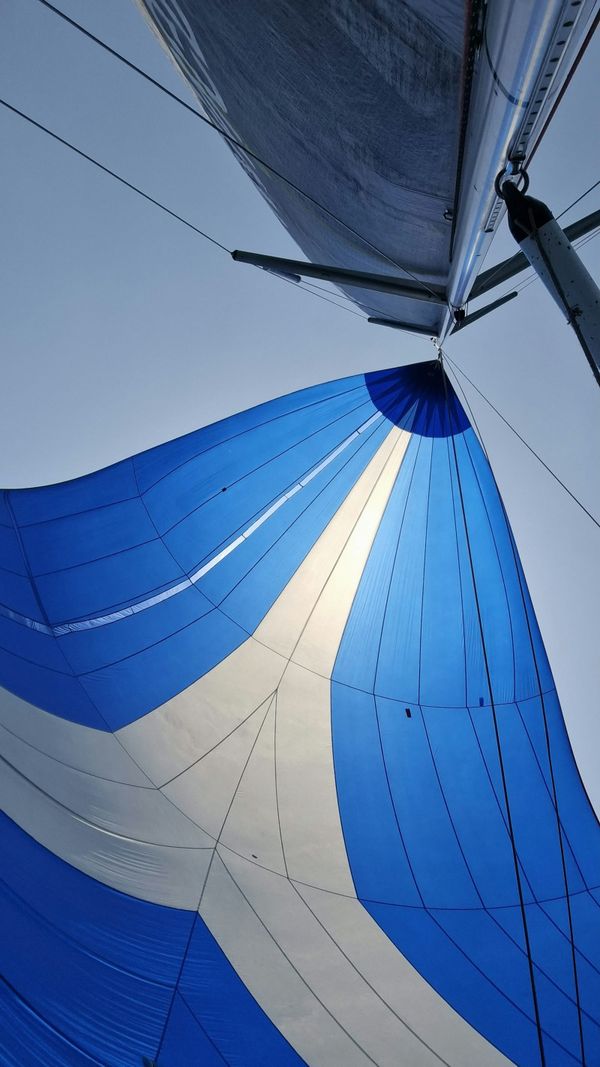
The asymmetric spinnaker (set from a bowsprit or tacked to the bow) is the most versatile option for cruising boats. It provides enormous area for light-air reaching and broad reaching — the angles where a genoa loses power. Modern asymmetrics in cruising weights are manageable for a shorthanded crew, especially with a sock (snuffer) for controlled deployment and dousing.
Alternatively, a cruising code zero on a furler provides a more conservative option — less area than a spinnaker but deployable and furled from the cockpit without going forward. It's a reaching sail more than a running sail, best suited to apparent wind angles of 60-120 degrees.
For dead downwind work in the trades, many cruisers pole out the genoa to windward with the mainsail broad off to leeward — the classic "wing and wing" configuration. A whisker pole (or a spinnaker pole repurposed) keeps the genoa set and stable. This is simple, controllable, and sustainable for days, which is exactly what a trade wind crossing demands.
Sail Material
For bluewater cruising, Dacron (woven polyester) remains the material of choice for working sails. It's durable, UV-resistant, repairable in the field with basic sailmaking tools, and retains acceptable shape over thousands of miles. Dacron sails last 8-15 years with proper care — longer than laminate sails, which delaminate and lose shape faster.
Laminate sails (Mylar-based composites) hold their designed shape better and are lighter, but they're fragile by comparison, difficult to repair at sea, and have a shorter lifespan in the UV-intense tropical environment. For a cruising boat that will carry the same sails for years across multiple oceans, Dacron's durability advantage outweighs laminate's performance advantage.
The exception is the downwind sail, where a lightweight nylon or polyester laminate makes sense — these sails see less UV (they're only set in specific conditions) and the weight savings is meaningful for a sail that large.
Sail Care
UV degradation is the primary killer of sails in the tropics. A genoa on a furler with an inadequate UV strip will lose years of life from sun exposure alone.
UV protection. Ensure your furling genoa has a full-length UV strip on the leech and foot — sacrificial fabric that takes the sun damage while the sail is furled. Inspect the UV strip annually and replace it when it shows significant fading or deterioration. A mainsail left uncovered on the boom degrades fast; use a mainsail cover whenever the sail is not in use.
Chafe. The silent destroyer. Sails chafe against spreader tips, shrouds, lifelines, and any hardware they contact repeatedly. Inspect chafe patches and spreader boots regularly. Add sacrificial chafe patches at known contact points before the sail fabric is damaged. A strip of sticky-back Dacron tape on a chafe-prone area is a five-minute preventive measure.
Washing. Salt crystallizes in the sail fabric and accelerates UV degradation and mildew. Rinse sails with fresh water periodically — especially before extended storage. A full wash in a sail bath (soak in mild detergent, rinse thoroughly, dry completely) every year or two removes accumulated salt and organic growth.
Storage. Sails not in use should be stored dry, flaked loosely (not stuffed), in UV-protected bags. Never store a wet or damp sail — mildew will colonize the fabric within days in tropical conditions.
Sail Repair at Sea
Every bluewater boat should carry a sail repair kit and a crew member who knows how to use it. The minimum kit includes: a sailmaker's palm, heavy needles (assorted sizes), waxed polyester thread (V-69 and V-92), Dacron repair tape (sticky-back), sailcloth patches in weights matching your sails, a hotknife or lighter for sealing edges, a seam ripper, scissors, and webbing for reinforcements.
The repairs you're most likely to make at sea: patching a chafe hole or small tear, re-stitching a seam that's let go, reinforcing a batten pocket, and replacing a damaged clew or tack ring with webbing and hand-stitching. None of these require a sewing machine or professional skill — just patience, a sailmaker's palm, and practice.
Practice at home. Take an old sail, cut a hole in it, and repair it. Rip a seam and re-stitch it. The skills are simple but manual — the palm takes practice to use effectively, and stitching through multiple layers of Dacron requires technique. Better to develop that technique in your garage than on a heaving foredeck at 0200.
The sail inventory is the engine of a sailing vessel. Choose it thoughtfully, maintain it obsessively, and learn to repair it at sea. A well-found suit of sails, properly cared for, will carry you around the world.
References: North Sails, Quantum Sails, Andy Schell (59° North Sailing), Yachting World, Practical Sailor