Monohull or Catamaran: An Honest Comparison for Bluewater Sailing
Monohull or Catamaran - practical insights for the bluewater cruiser.
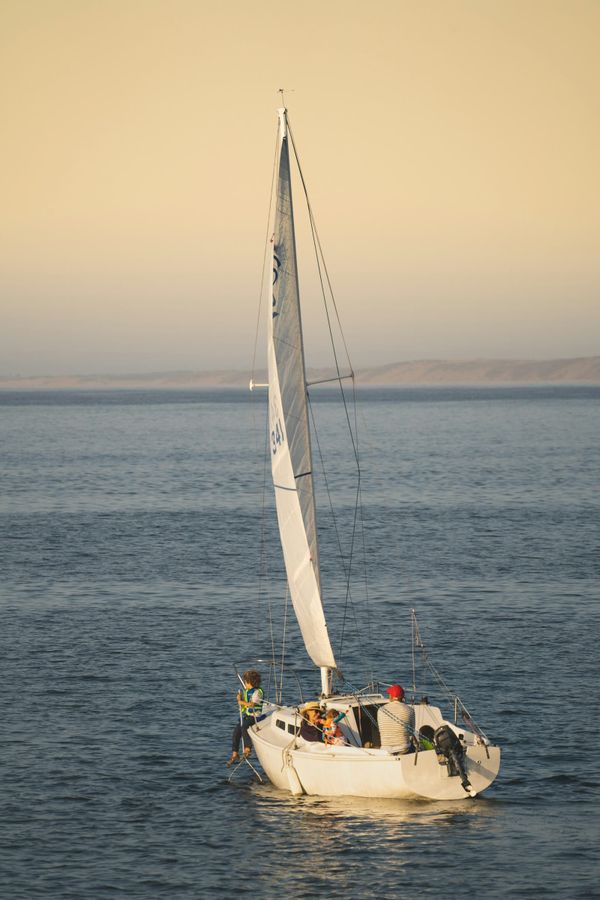
This is the question that launches a thousand forum arguments and ends zero of them. Monohull sailors think catamaran sailors are floating-condo dilettantes who can't actually sail. Catamaran sailors think monohull sailors are masochists clinging to tradition while heeled at 20 degrees and eating dinner off their laps. Both are wrong, both are right, and neither boat type has a monopoly on ocean-crossing capability.
What follows is an attempt at an honest comparison — not to declare a winner, but to help you match the right platform to your specific cruising plans, crew, budget, and priorities. Because the right boat is the one that fits your life, not the one that wins the argument.
Space and Living
This is the catamaran's most obvious advantage, and it's not subtle. A 42-foot catamaran has roughly the living space of a 55-foot monohull — wider saloon, larger galley, bigger cabins, more storage, and a cockpit that functions as an outdoor living room. For liveaboard cruisers, families, and anyone who plans to spend years aboard rather than weeks, the space difference is transformative.
The monohull's interior, by contrast, is a masterclass in efficient space utilization within a narrow hull. Everything is reachable. Handholds are always within arm's length. The galley is designed to be worked while braced against the motion. The v-berth is snug. It's a boat that feels like a boat — which, depending on your perspective, is either its charm or its limitation.
The catamaran also provides level living. No heeling. Your coffee stays in the cup. Books stay on the shelf. Dinner stays on the plate. This sounds trivial until you've spent three weeks on a monohull in the trades, where 15-20 degrees of heel is the default and everything aboard migrates to the leeward side.
Sailing Performance
Monohulls point higher. A well-designed monohull with a deep fin keel will sail 30-35 degrees to the apparent wind in moderate conditions. Most cruising catamarans can't get closer than 45-50 degrees without making excessive leeway. On a windward passage, the monohull's ability to sail closer to the wind translates directly into shorter distances and faster arrivals.
Catamarans are faster off the wind. On a reach or a run — which is the majority of trade wind sailing — a catamaran's wider beam, reduced wetted surface, and twin hull efficiency produce higher average speeds. A 45-foot performance catamaran will average 7-9 knots on a trade wind passage where a comparable monohull averages 6-7 knots. Over a 2,500-mile Atlantic crossing, that speed difference translates to 2-4 fewer days at sea. That's meaningful — both for comfort and for weather window management.
Catamarans don't heel, but they do pitch. The motion in a seaway is different, not absent. Short, steep seas can produce a hobby-horsing motion that some people find more uncomfortable than a monohull's steady heel. In following seas, catamarans can develop a corkscrewing motion as each hull rises and falls alternately. These are liveable — millions of catamaran ocean miles prove it — but the myth that catamarans don't move in a seaway is just that.
Safety and Stability
This is where the discussion gets heated, because it touches on the fundamental physics of each design.
A well-designed monohull has positive stability to high angles of heel — typically 120-140 degrees for an offshore-capable design. If knocked down past 90 degrees, even inverted, the ballasted keel provides a powerful righting moment that returns the boat upright. Monohulls can and do recover from full inversions. The 1979 Fastnet disaster, the 1998 Sydney-Hobart, and countless individual incidents have demonstrated that well-built monohulls survive capsizes.
A catamaran's stability curve is fundamentally different. Catamarans are extremely resistant to capsize — the wide beam means enormous initial stability, and it takes extraordinary forces (typically a breaking wave of significant height hitting beam-on) to flip one. But once inverted, a catamaran is stable upside down. The wide, flat platform that provides stability right-side up provides equal stability inverted. A capsized catamaran will not right itself.
The practical implication: catamarans are harder to capsize but more dangerous if capsized. Monohulls are easier to knock down but will right themselves. The statistical record shows that both types cross oceans safely in large numbers. The risk profile is different, not inherently better or worse — but it's a difference that should inform your heavy weather strategy, your route planning, and your comfort with each platform's failure mode.
A capsized catamaran does remain floating and habitable (upside down) — which is arguably better than a sinking monohull. Several survival stories involve catamaran crews sheltering inside the inverted hull for days until rescue. This is cold comfort when you're floating upside down, but it's a genuine survival advantage over a monohull that's taken on water and is going down.
Anchoring and Draft
Catamarans draw less water — typically 3-5 feet versus 5-7 feet for a comparable monohull. In the Bahamas, the Pacific atolls, and anywhere with extensive shallows and reef-studded anchorages, the catamaran accesses places the monohull can't reach. This isn't a minor advantage. Some of the best cruising grounds in the world are in shallow water.
The catamaran's wider swing radius at anchor is the offsetting consideration. A 45-foot catamaran on 7:1 scope swings through a much larger circle than a 45-foot monohull, because the beam adds to the effective swing diameter. In crowded anchorages, this limits your options. Catamaran sailors learn to anchor with consideration for their footprint — or develop a thick skin about the complaints from monohull neighbors.
Catamarans can be beached (deliberately dried out for bottom work) in locations where monohulls can't, and they're stable when dried out on their twin keels. This is a practical advantage for bottom maintenance in remote areas without haul-out facilities.
Cost
Catamarans cost more. A new production catamaran costs roughly 50-80% more than a monohull of equivalent length and build quality. The used market is tighter — catamarans retain value well, and demand consistently outstrips supply in the 40-50 foot range. Marina fees are higher because catamarans take wider berths. Haul-outs are more expensive because catamarans require wider travel lifts. Insurance premiums are typically 10-20% higher.
The 47-point worksheet I'm using to score our family's circumnavigation boat — 8 reference cats pre-scored, 4 mission-tuned weighting profiles, red-flag auto-disqualifiers. Free PDF and Excel. Send me the worksheet → No spam. One email a week. Unsubscribe anytime.
The monohull's cost advantage is significant at every stage: purchase, berthing, maintenance, insurance, and resale. For a given budget, you can buy a better-equipped, better-maintained monohull than catamaran.
The catamaran's counter-argument: you're buying two boats' worth of living space, better average passage speeds (which reduce provisioning and wear), and shallower draft access to more anchorages. Whether the premium is justified depends entirely on your priorities.
Maintenance and Systems
Catamarans have two of everything below the waterline: two hulls to antifoul, two rudders, two engines, two sets of through-hulls. This doubles some maintenance tasks but provides redundancy — lose an engine and you can still motor on one. Lose a rudder and you still have one (sort of).
Monohulls are mechanically simpler: one engine, one rudder, one hull. Maintenance is concentrated in one engine room, one bilge, one set of systems. For the mechanically inclined sailor who does their own work, simplicity has real value.
The catamaran's bridge deck — the structure spanning the two hulls — is a structural weak point that requires attention. Bridge deck slamming in steep head seas creates enormous loads. This is a design consideration, not a flaw, but it's one that poorly designed or overloaded catamarans suffer from more than well-designed ones.
The Decision Framework
Choose a catamaran if: you prioritize living space and comfort, you'll be cruising with family or a larger crew, your route is primarily downwind or in shallow-water cruising grounds, level sailing matters to you or a crew member with mobility issues, you can afford the premium in purchase price and ongoing costs, and you're comfortable with the inverted-stability risk profile.
Choose a monohull if: you prioritize sailing performance (especially upwind), your budget is a primary constraint, you value simplicity and mechanical accessibility, you'll be sailing in higher latitudes or more demanding conditions where self-righting is a meaningful safety factor, you prefer the traditional feel and motion of a keelboat, or marina access and berthing costs are considerations.
Choose either if: you're crossing oceans. Both do it safely, routinely, and in large numbers. The best bluewater boat is the one you know, maintain, and sail well — regardless of hull count.
References: Jimmy Cornell's fleet surveys, Practical Sailor, Yachting World, Multihulls World, ARC/World ARC fleet data